Mid ~1000 Wh class
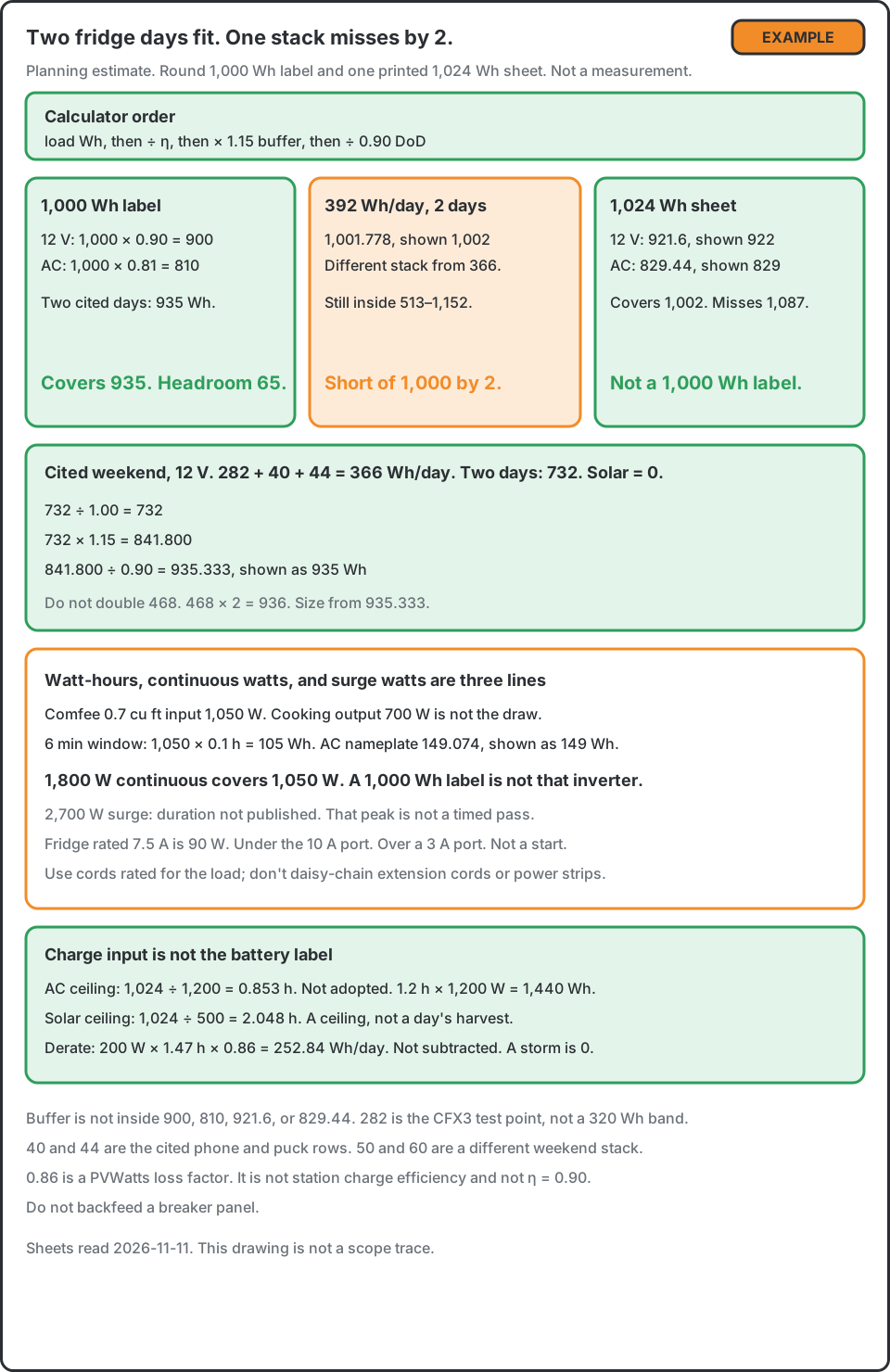
Results from 513 Wh through 1,152 Wh land in this class. A round 1,000 Wh label delivers 900 Wh on 12 V and 810 Wh on AC. Two cited fridge days on 12 V name to 935 Wh and fit that label. A different weekend stack names to 1,002 Wh and misses the label by 2 Wh. The class name is not the label. Sheets below were read 2026-11-11.
What a label in this class delivers
Same order as js/calculator.js. Round the full quotient once, half-up, the way Math.round does. Do not round the middle steps and then keep going. DoD=0.90 is a planning fraction of the label. It is not a BMS guarantee. The 15% buffer is headroom, not a measured loss. The runtime check does not apply the buffer again on the way down.
1,000 Wh is a round planning label. It is not a claim that a box is printed that way. The DELTA 2 manual prints 1,024 Wh (51.2 V). That sheet is already the ~1,000 Wh example on 1,000 vs 2,000 Wh. It is one manual in this watt-hour band. It is not a ranking. Do not shop the sheet’s delivered watt-hours as if they were the round 1,000 label. The step down, where a 500 Wh label still covers a day, is under ~500 Wh.
| Label | 12 V / USB delivered | AC delivered |
|---|---|---|
| 1,000 Wh, round | 1,000 × 0.90 = 900 Wh | 1,000 × 0.81 = 810 Wh |
| 1,024 Wh, printed sheet | 1,024 × 0.90 = 921.6 → 922 Wh | 1,024 × 0.81 = 829.44 → 829 Wh |
The 900 and 810 products are exact. 921.6 and 829.44 are the unrounded sheet products. Round those once for the display. Runtime on the sheet divides 921.6 or 829.44, not 922 or 829. The 829 Wh AC figure is the same product already on EcoFlow vs Jackery vs Bluetti. Do not shop 829 Wh as if it were the round label’s 810 Wh, or 922 Wh as if it were 900 Wh.
Class spans on this site, from the sizing walkthrough: results up to 512 Wh, then 513–1,152 Wh, then 1,153 Wh and up. “Inside this class” means the rounded nameplate sits in 513–1,152. It does not mean a round 1,000 Wh label covers it. Shop the buffered nameplate against the printed label. A miss past 1,152 Wh is ~2,000 Wh and up.
810 Wh and 809 Wh are not the same quantity. 810 Wh is what a round 1,000 Wh label delivers on AC. The published camping sample on weekend camping is 570 Wh/day. That page itemizes it. The fridge figure in that sample is a 320 Wh/day planning band, not the CFX3 282 Wh/day test point below. One AC day of that sample is 570 × 1.15 / 0.81 = 809.259 → 809 Wh. That 809 Wh is the shopping nameplate. A 1,000 Wh label covers it. Headroom is 1,000 − 809 = 191 Wh. Two AC days are 1,618.519 → 1,619 Wh, which is past 1,152 Wh. Runtime, buffer off: 810 / 570 = 1.421 days. That is not two days.
Weekend: fridge, puck lights, and phones
Solar = 0. The fridge figure is the CFX3 35 test point, the same 282 Wh/day used on camping fridge. The sheet lists 0.98 Ah/h at 12 V DC, ambient 90°F, internal 39°F, volume 36 L. 0.98 × 12 × 24 = 282.24, published as 282 Wh/day. The 0.24 is not re-added. Dometic’s lead-acid note is a different battery. It is not this site’s 0.90 DoD.
The same electrical table prints rated DC current 7.5 A, rated AC power 50 W, and rated AC current 0.78 A at 120 V. 7.5 × 12 = 90 W. 0.78 × 120 = 93.6 VA, which is volt-amps, not watts. Real watts also depend on power factor, which is not on that sheet. The 90 W DC rating, the 93.6 VA apparent power, and the 50 W AC rating are distinct. Do not substitute them for the daily energy figure. Average power at the test point is 282 / 24 = 11.75 W. 50 W × 24 h = 1,200 Wh is the rated AC input held all day, not this test point.
The phone row is the Apple 20 W USB-C adapter ceiling, the same 20 W × 1 h × 2 already on 500 vs 1,000 Wh. A phone often draws less, so 40 Wh is a ceiling. Two phones and one hour are this day. The lamps are four Stanpro 67168 pucks at 2.2 W, 12 V. Four pucks and 5 h are this day. The hub is not sized. A second published stack, 282 + 50 + 60 = 392 Wh, uses the weekend planning allowances on weekend camping. It is not this cited day.
| Load | Basis | Wh/day | Path |
|---|---|---|---|
| CFX3 35 | 0.98 Ah/h × 12 V × 24 h = 282.24, published as 282. | 282 | 12 V, η=1.00 |
| Two phones | Apple 20 W USB-C adapter × 1 h × 2. | 40 | USB, η=1.00 |
| Four Stanpro 67168 pucks | 2.2 W × 4 × 5 h. | 44 | 12 V, η=1.00 |
| Cited day | 282 + 40 + 44. | 366 | One DC pass |
All on 12 V and USB. Steps are load ÷ 1.00, × 1.15, ÷ 0.90. One day of this stack names to 468 Wh, which is the under-500 class. The weekend, two days with solar at zero, is the plan that shops here.
| Plan, solar = 0 | Steps | Exact | Nameplate |
|---|---|---|---|
| Cited, 1 day, 12 V | 366.000 → 420.900 → nameplate | 467.667 | 468 Wh |
| Cited, 2 days, 12 V | 732.000 → 841.800 → nameplate | 935.333 | 935 Wh |
| Cited, 1 day, AC | 366 ÷ 0.90 = 406.667; × 1.15 = 467.667; ÷ 0.90 | 519.630 | 520 Wh |
| Cited, 2 days, AC | 732 ÷ 0.90 = 813.333; × 1.15 = 935.333; ÷ 0.90 | 1,039.259 | 1,039 Wh |
| Allowances, 2 days, 12 V | 392 × 2 = 784. Not the 366 day. | 1,001.778 | 1,002 Wh |
| Allowances, 2 days, AC | 784 on the inverter. | 1,113.086 | 1,113 Wh |
366 × 2 × 1.15 / 0.90 = 935.333 → 935 Wh
366 × 2 × 1.15 / 0.81 = 1,039.259 → 1,039 Wh
392 × 2 × 1.15 / 0.90 = 1,001.778 → 1,002 Wh
Do not double the rounded day. 468 × 2 = 936. The two-day cited quotient is 935.333, which rounds to 935 Wh. A 1,000 Wh label covers 935. Headroom is 1,000 − 935 = 65 Wh. A 1,024 Wh sheet covers it. Moving the same 732 Wh onto AC names to 1,039 Wh. A round 1,000 Wh label is short by 39 Wh. The sheet is short by 1,039 − 1,024 = 15 Wh. 1,039 is still inside 513–1,152.
The allowance stack is the other published weekend. Two days on 12 V name to 1,002 Wh. A round 1,000 Wh label is short by 2 Wh. The result is still inside this class. A 1,024 Wh sheet covers 1,002 because 1,024 ≥ 1,002. Two days on AC name to 1,113 Wh. That misses both the round label and the 1,024 Wh sheet, and it is still under the 1,152 Wh class ceiling. One AC day of the cited 366 Wh stack is 520 Wh. Of this cited day’s two one-day plans, that is the one that crosses 512 Wh. The rounded nameplate is 8 Wh over 512.
Runtime on the cited day, buffer off. A 1,000 Wh label delivers 900 Wh on 12 V: 900 / 366 = 2.459 days, and (900 / 366) × 24 = 59.016 hours at that day’s average. On AC, 810 / 366 = 2.213 days, and (810 / 366) × 24 = 53.115 hours. Do not multiply the rounded day: 2.213 × 24 = 53.112. On the sheet, divide the unrounded product: 921.6 / 366 = 2.518 days on 12 V, and 829.44 / 366 = 2.266 days on AC. Do not divide 922 or 829. Two unbuffered days fit. The buffer is what separates 935 Wh, which the label covers, from 1,039 Wh, which it does not.
One outage day: camping fridge, router, and CPAP
Solar = 0. This is not a full-size kitchen fridge. The sticker day for that refrigerator is on home outage and on 1,000 vs 2,000 Wh. It is past this class. The fridge here is the same CFX3 test point, counted once for the outage day, not halved. The router window is 12 h. The CPAP window is 8 h. Those three windows are one planning day. They are not a flat 24 h draw.
The router is the GL.iNet GL-MT3000. The product page prints power consumption as <8 W and power input as Type-C, 5 V / 3 A. 5 × 3 = 15 W is the port rating, not the night. Ceiling: 8 W × 12 h = 96 Wh. The CPAP figures are the AirSense 10 rows already on CPAP, from ResMed’s battery guide (198103/7, 2018-08). The worked pressure is the printed 10 cm H2O column. It is not a recommended setting. This page does not set pressure, humidity, or tube heat. The guide says the amp-hour column is the battery size for 8 hours. This page’s watt-hours are the printed current × 12 V × 8 h. The amp-hour cell is not used as a station nameplate.
| Load | Basis | Wh | Path |
|---|---|---|---|
| CFX3 35 | Same 282 Wh test point. One outage day. Not halved. | 282 | 12 V, η=1.00 |
| GL-MT3000 | Ceiling 8 W × 12 h. The page prints <8 W. | 96 | USB, η=1.00 |
| SlimLine only | 0.93 A × 12 V × 8 h. Light row, so the label can be checked. | 89.28 | DC converter, η=1.00 |
| ClimateLineAir at 30°C, humidifier setting 8 | 4.92 A × 12 V × 8 h. The heavy row. | 472.32 | DC converter, η=1.00 |
| Heavy day | 282 + 96 + 472.32. The page uses the literal 850.32. | 850.32 | One DC pass |
| Slim day | 282 + 96 + 89.28. | 467.28 | One DC pass |
ResMed’s guide recommends a DC-to-DC converter. Its inverter steps name other ResMed machines and only the HumidAire 2i, H4i, and H5i humidifiers. They do not name AirSense 10 with HumidAir. The same section warns: “Other ResMed heated humidifiers must not be used with inverters. Damage to the unit or serious injury to the user may result.” A station’s AC outlet is an inverter. The AC rows below are watt-hour arithmetic only. They are not a setup and not an approval. Where that guide does allow an inverter, it asks for pure sine wave, 300 W continuous and 500 W peak. Check your device manual and the label on your power brick for your exact model.
Heavy day, all on the DC convention. Steps: 850.320 → 977.868 → 1,086.520. Two days: 1,700.640 → 1,955.736 → 2,173.040.
850.32 × 1.15 / 0.90 = 1,086.52 → 1,087 Wh
850.32 × 2 × 1.15 / 0.90 = 2,173.04 → 2,173 Wh
467.28 × 1.15 / 0.90 = 597.08 → 597 Wh
Do not double the rounded day. 1,087 × 2 = 2,174. The two-day quotient rounds to 2,173 Wh. One heavy day names to 1,087 Wh. That is inside 513–1,152, so the class name still says ~1,000 Wh. A round 1,000 Wh label is short by 1,087 − 1,000 = 87 Wh. A 1,024 Wh sheet is short by 1,087 − 1,024 = 63 Wh. Shop a printed label of at least 1,087 Wh. The class ceiling is not that label. Two heavy days name to 2,173 Wh and leave the class. The slim day names to 597 Wh. A 1,000 Wh label covers it. Headroom is 1,000 − 597 = 403 Wh.
Runtime, buffer off, heavy day on the DC convention. A 1,000 Wh label delivers 900 Wh: 900 / 850.32 = 1.058 days, and (900 / 850.32) × 24 = 25.402 hours at that day’s average. Do not multiply the rounded day: 1.058 × 24 = 25.392. The unbuffered energy covers one day. The buffered plan is 1,087 Wh, which the label does not. On the sheet, 921.6 / 850.32 = 1.084 days. Do not divide 922. The slim day on a 1,000 Wh label: 900 / 467.28 = 1.926 days.
Math only, not a setup. ResMed’s guide warns against heated humidifiers on inverters (above). If the heavy CPAP row were on an AC supply, with the fridge and the router on DC, the path changes. Add the exact passes, then round once. DC pass: 378 × 1.15 / 0.90 = 483 exactly, which rounds to 483 Wh alone. AC pass: 472.32 × 1.15 / 0.81 = 670.578, which rounds to 671 Wh alone. The full sum is 1,153.578, which rounds to 1,154 Wh. The displays add to 483.000 + 670.578 = 1,153.578. Rounded passes add to 483 + 671 = 1,154. Size from the full sum anyway.
378 × 1.15 / 0.90 + 472.32 × 1.15 / 0.81 = 483 + 670.577… = 1,153.578 → 1,154 Wh
1,154 is past 1,152 by 2 Wh. The same loads on the DC convention stayed inside the class at 1,087 Wh. On AC they are the large class. Battery draw before the buffer: 378 + 472.32 / 0.90 = 378 + 524.8 = 902.8 Wh. A 1,000 Wh label covers (1,000 × 0.90) / 902.8 = 0.997 of that day. Hours at the average are (900 / 902.8) × 24 = 23.926. The unbuffered energy is already short. If the whole 850.32 Wh moves onto AC, one day is 850.32 × 1.15 / 0.81 = 1,207.244 → 1,207 Wh, also past 1,152.
Van: a laptop and a fan, then the fridge day
Engine off. Solar = 0. One MacBook Air 13-inch (M3, 2024) recharge uses the published 52.6 Wh pack as a floor. Charger loss above that pack is not on the spec page, so it is not added. The 30 W USB-C adapter on that page (included with the 8-core GPU model) is a watts rating. It is not multiplied by hours. The fan is a Caframo Sirocco II on high, 0.35 A on the 12 V column. The 24 V column, 0.21 A, is not used. Low 0.12 A and medium 0.22 A were on the same table and are not this row. 0.35 × 12 = 4.2 W. The page prints a timer of 3, 6, 9, or 12 hours. This row uses 12 h: 4.2 × 12 = 50.4 Wh. A 6 h step is 4.2 × 6 = 25.2 Wh.
52.6 + 50.4 = 103 Wh for a 12 h fan day
52.6 + 25.2 = 77.8 Wh for a 6 h fan day
103 × 1.15 / 0.90 = 131.611 → 132 Wh
77.8 × 1.15 / 0.90 = 99.411 → 99 Wh
One of those days names to 132 Wh or 99 Wh. Both sit under a 300 Wh label. They are not why this class exists. The same arithmetic is already on 500 vs 1,000 Wh. Count the 12 h day out until the nameplate crosses a class edge. Do not multiply the rounded 132 Wh day. 132 × 4 = 528, 132 × 7 = 924, and 132 × 8 = 1,056. The quotients below are the shopping numbers.
| 12 h fan day, 12 V, solar = 0 | Load Wh | Exact | Nameplate |
|---|---|---|---|
| 1 day | 103 | 131.611 | 132 Wh |
| 3 days | 309 | 394.833 | 395 Wh. Still under 512. |
| 4 days | 412 | 526.444 | 526 Wh. First of these inside 513–1,152. |
| 7 days | 721. Steps 721.000 → 829.150. | 921.278 | 921 Wh |
| 8 days | 824. Steps 824.000 → 947.600. | 1,052.889 | 1,053 Wh |
103 × 7 × 1.15 / 0.90 = 921.278 → 921 Wh
103 × 8 × 1.15 / 0.90 = 1,052.889 → 1,053 Wh
A 1,000 Wh label covers 7 of these days. Headroom is 1,000 − 921 = 79 Wh. It is short of 8 days by 1,053 − 1,000 = 53 Wh. A 1,024 Wh sheet is short of that eighth day by 1,053 − 1,024 = 29 Wh. 1,053 is still inside 513–1,152. Runtime, buffer off: 900 / 103 = 8.738 days, and (900 / 103) × 24 = 209.709 hours at that day’s average. Do not multiply the rounded day: 8.738 × 24 = 209.712.
Add the fridge, and the day that shops this class over two days is the one already on 1,000 vs 2,000 Wh and on van daily Wh. 12 h fan, laptop floor, CFX3 test point, all DC or USB: 282 + 50.4 + 52.6 = 385 Wh/day. One day names to 491.944 → 492 Wh, still under 512. Two days: 983.889 → 984 Wh. Three days: 1,475.833 → 1,476 Wh.
385 × 2 × 1.15 / 0.90 = 983.889 → 984 Wh
385 × 3 × 1.15 / 0.90 = 1,475.833 → 1,476 Wh
A 1,000 Wh label covers two of these days. Headroom is 1,000 − 984 = 16 Wh. A 1,024 Wh sheet covers 984. Three days are past 1,152 Wh. That third day with no recharge is the large class. Runtime on 12 V, buffer off: 900 / 385 = 2.338 days, and (900 / 385) × 24 = 56.104 hours. Do not multiply the rounded day: 2.338 × 24 = 56.112. On the sheet, 921.6 / 385 = 2.394 days. Do not divide 922.
A microwave fits the watt-hours. The fridge port is not a start proof.
Stored energy can pass while the inverter’s continuous line is a separate check. A magnetron cook lasts minutes. The surge cell is not those minutes. No surge multiple is invented here. No scope trace. The same oven is on 500 vs 1,000 Wh and on surge traps.
The Comfee manual for AM720C2RA-R, AM720C2RA-A, and AM720C2RA-G prints 120 V, 60 Hz, rated microwave input 1,050 W, rated microwave output 700 W, capacity 0.7 cu ft. 700 W is cooking output. The wall draw on that sheet is 1,050 W. The sheet does not print a power factor, so this page does not invent one. It prints no start inrush either. Six minutes is this page’s reheat window, not a cook on the sheet.
1,050 W × (6/60) h = 105 Wh
105 × 1.15 / 0.81 = 149.074 → 149 Wh
A 1,000 Wh label delivers 810 Wh on AC, which is 810 / 105 = 7.714 of those windows. A 1,024 Wh sheet delivers 829.44 Wh on AC, 829.44 / 105 = 7.899 windows. Do not divide the rounded 829 Wh. Both store one cook. Neither quotient turns the oven on by itself.
On the DELTA 2 sheet, read 2026-11-11, AC output is pure sine, 1,800 W total (surge 2,700 W), 120 V. Duration of that surge cell is not published. That peak is not a timed pass. 1,050 W is under the 1,800 W continuous line, so this oven alone is a continuous-watts pass on that sheet. It is not a pass on the round 1,000 Wh label, because that label does not state an inverter wattage. Buying watt-hours does not buy the 1,800 W line. The sheet’s max device power supported by X-Boost is 2,200 W. The manual enables it when output exceeds rated power, says it is not for appliances with voltage protection, says it is more suitable for heating devices, and says to test. The manual says X-Boost is not available when the AC output is on in a recharging state (bypass mode), and not available when X-Boost is disabled. EcoFlow’s X-Boost page says it “marginally reduces voltage”; it gives no volt figure. WattNeeds sizing rule, stricter than the manual’s heating-devices line: voltage-reduction lift modes are for resistive heating loads only. Reduced voltage can stall or overheat motor and compressor loads. Not a surge rating. Do not size on it. This cook does not need that line. 1,800 W continuous already covers 1,050 W.
The fridge is the other watts check, and the sheet does not print a start surge. Rated DC current is 7.5 A, which is 90 W, not the 11.75 W average. The DELTA 2 car outlet is 12.6 V, 10 A, 126 W max, shared with the DC5521 ports. Each DC5521 port is 12.6 V, 3 A, 38 W max. 7.5 A is over 3 A, so the rated current does not fit a DC5521 port. 7.5 A is under 10 A, and 90 W is under 126 W. That is a rating comparison on the car outlet. It is not a compressor start. The CFX3 sheet prints no locked-rotor amp. None is invented. An input that fails the 1,800 W continuous line is a different appliance. The oven case on 1,000 vs 2,000 Wh is that miss. Use cords rated for the load; don't daisy-chain extension cords or power strips. Do not backfeed a breaker panel. The oven plugs into the station, not into a house circuit through the panel.
Charge input is not the watt-hour label
Four numbers on one box do different jobs. Battery watt-hours are the label. Continuous watts are what the inverter can hold. Surge watts are a separate cell, and on this sheet that cell’s duration is not published. Charge input is how fast the label can be filled, and only as a ceiling. The 0.90 factor on this site is not in the divisions below.
| Line | DELTA 2 manual, read 2026-11-11 |
|---|---|
| Printed capacity | 1,024 Wh, 51.2 V. Not a 1,000 Wh label. |
| Cell chemistry / cycle life | LFP, 3,000 cycles to 80%+ capacity. Not doubled because the class is larger than 512 Wh. Not converted into years. DoD=0.90 is not that cycle test. The chemistry primer is LiFePO4 vs NMC. |
| AC output | Pure sine, 1,800 W total (surge 2,700 W), 120 V. Duration not published. That peak is not a timed pass. |
| X-Boost | The sheet’s max device power supported by X-Boost is 2,200 W. Not the pass for the 1,050 W oven. Not a surge rating. |
| AC charge | X-Stream 1,200 W max, 10 A, 100–120 V. The AC charging section also prints “≈1.2 hrs Full Charge.” The app can change the AC charging speed. |
| Solar input | 11–60 V, 15 A, 500 W max. Keep panel voltage inside that range. 500 W is a ceiling, not a day’s harvest. This page does not repeat the manual’s series-wiring figure. |
| Car charge input | 12 V / 24 V battery, default 8 A. The spec line does not print a watt. This page does not invent one. |
| 12 V output | Car outlet 12.6 V, 10 A, 126 W max, shared with DC5521. Each DC5521 port is 12.6 V, 3 A, 38 W max. |
| Weight, as printed | Approximately 12 kg (27 lb). The manual prints both. This page does not convert them and does not divide watt-hours by kilograms. |
1,024 / 1,200 = 0.853 h
1.2 × 1,200 = 1,440 Wh
0.853 h is the 1,024 Wh label divided by the 1,200 W maximum, as if that maximum held for the whole fill and every watt-hour stuck. The manual’s printed “≈1.2 hrs Full Charge” is a different number. 1,440 Wh is not the 1,024 Wh label. This page does not adopt 0.853 h or 1.2 h as a calculated recharge. Do not turn 1,200 W × 1 h into a 1,200 Wh battery.
1,024 / 500 = 2.048 h
2.048 h is the same kind of ceiling: the label divided by the 500 W solar-input maximum, held for the whole fill. It is not a harvest. A 200 W panel cannot hold that 500 W port at 500 W.
Harvest on this page is the product already on solar vs battery. It is not a new PVWatts request. The hours are that guide’s Seattle planning hours, 3.99 for the year and 1.47 for December, at 30° tilt. The 0.86 is PVWatts Version 5’s own conversion of its default system loss, “1 − 14/100 = 0.86,” from the Version 5 manual. This page uses that 0.86. It does not substitute an unrounded loss product. The manual keeps inverter efficiency out of that factor. 0.86 is not station charge efficiency, not cell temperature, and not this site’s η=0.90.
200 × 3.99 × 0.86 = 686.28 Wh/day
200 × 1.47 × 0.86 = 252.84 Wh/day
Those are the solar guide’s simple planning rows, which that guide counts at the battery and labels as an upper estimate. They are not subtracted from the nameplate. Every nameplate above has solar = 0. A storm or a dense canopy is 0, which is already how those nameplates are built. 252.84 Wh is one December planning day from a 200 W panel. It does not refill a 1,024 Wh label. The ratio of the label to that row is 1,024 / 252.84 = 4.050. The ratio of a round 1,000 Wh label to the same row is 1,000 / 252.84 = 3.955. Both are energy ratios. They are not charge times. They assume the planning hours actually occur, and they do not add another charge-efficiency loss. The annual row is 1,024 / 686.28 = 1.492 of those planning days per label, with the same limits. Panel voltage stays inside 11–60 V. This page does not give a stringing procedure.
Where this class is enough
“Covers” means that label is at least the buffered nameplate. “Inside the class” means the rounded nameplate is from 513 Wh through 1,152 Wh. The microwave row stores the energy and still has to pass the 1,800 W line above. The 570 Wh rows are the published camping sample, not the cited 366 Wh day.
| Buffered plan | Nameplate | 1,000 Wh label | 1,024 Wh sheet |
|---|---|---|---|
| Cited camp, 366 Wh, 1 day, 12 V | 468 Wh | Covers. Under 512. Not this class. | Covers |
| Cited camp, 2 days, 12 V, solar = 0 | 935 Wh | Covers. Headroom 65 Wh. | Covers |
| Cited camp, 1 day, AC | 520 Wh | Covers. Inside 513–1,152. | Covers |
| Cited camp, 2 days, AC | 1,039 Wh | Short by 39 Wh. Inside the class. | Short by 15 Wh. |
| Allowance weekend, 392 Wh, 2 days, 12 V | 1,002 Wh | Short by 2 Wh. Inside the class. | Covers |
| Allowance weekend, 2 days, AC | 1,113 Wh | Short. Inside the class. | Short. Under the 1,152 ceiling. |
| Camping sample, 570 Wh, 1 day, AC | 809 Wh | Covers. Headroom 191 Wh. 810 Wh delivered is not this nameplate. | Covers |
| Camping sample, 2 days, AC | 1,619 Wh | Short. Past 1,152. | Short |
| Outage, slim CPAP, 1 day, DC | 597 Wh | Covers. Headroom 403 Wh. | Covers |
| Outage, heavy CPAP, 1 day, DC | 1,087 Wh | Short by 87 Wh. Unbuffered runtime is 1.058 days. Inside the class. | Short by 63 Wh. Unbuffered runtime is 1.084 days. |
| Outage, heavy, CPAP on AC, 1 day (math only; ResMed warns against this humidifier on an inverter) | 1,154 Wh | Short. 2 Wh past 1,152. Large class. | Short |
| Outage, heavy, all on AC, 1 day (math only; same ResMed warning) | 1,207 Wh | Short. Past 1,152. | Short |
| Outage, heavy, 2 days, DC | 2,173 Wh | Short. Past 1,152. | Short |
| Van laptop + 12 h fan, 1 day | 132 Wh | Covers. Not this class. | Covers |
| Same van day, 7 days, 12 V | 921 Wh | Covers. Headroom 79 Wh. | Covers |
| Same van day, 8 days, 12 V | 1,053 Wh | Short by 53 Wh. Inside the class. | Short by 29 Wh. |
| Van fridge + laptop + 12 h fan, 2 days | 984 Wh | Covers. Headroom 16 Wh. | Covers |
| Same van day, 3 days, solar = 0 | 1,476 Wh | Short. Past 1,152. | Short |
| One 6 min microwave window | 149 Wh | Energy covers. The label states no inverter wattage. | Energy covers. 1,800 W continuous covers 1,050 W. Surge duration not published. That peak is not a timed pass. |
A round 1,000 Wh label is enough for two cited fridge days on 12 V, for one AC day of the 570 Wh camping sample, for one slim outage day, for seven laptop-and-fan van days, and for two van days that include the CFX3 test point. It is 2 Wh short of the allowance weekend on 12 V, 39 Wh short of the cited weekend on AC, and 87 Wh short of one heavy outage day on the DC convention. A printed 1,024 Wh sheet covers the 1,002 Wh allowance plan and still misses that heavy outage day. On paper, moving the heavy CPAP onto AC pushes the same day 2 Wh past the 1,152 Wh class ceiling. ResMed’s guide warns against running that heated humidifier from an inverter. A 1,050 W microwave is an energy pass and, on this sheet, a continuous-watts pass. The watt-hour class is not what makes that pass. A third fridge day in the van, or a second heavy outage day, is the large class.
Related: 500 vs 1,000 Wh · 1,000 vs 2,000 Wh · under ~500 Wh · ~2,000 Wh class · weekend camping · camping fridge · van daily Wh · home outage · CPAP · surge traps · solar vs battery
Wh calculator — one η per pass. 12 V and USB: set inverter efficiency to 1.00. AC outlets: leave η at 0.90. nameplate = (Wh/day × days × 1.15) / (0.90 × η).
Where to check pricing
As an Amazon Associate, we earn from qualifying purchases at no extra cost to you. EcoFlow, Jackery, and Bluetti partner programs are not live yet.
See on Amazon EcoFlow — Coming soon Jackery — Coming soon Bluetti — Coming soon