LiFePO₄ vs NMC
For a camp, van, or backup buy, the chemistry line changes three things you can check on a sheet: how many cycles are printed and to what leftover capacity, how many watt-hours the printed weight carries, and the temperature where charging stops. It does not change the watt-hours a fridge day needs. Sheets below were read 2026-11-16. Jackery and EcoFlow print NCM on the packs cited here. This URL says NMC. The handbook cited below prints NMC for the nickel-manganese-cobalt oxide. This page does not assign a nickel ratio the sheet does not print.
What the cycle line actually prints
Six official lines. The first four are LiFePO4 stations. The last two print NCM. The DELTA Max extra battery is a pack that its manual says cannot be used on its own. It is in the table because it is a primary NCM sheet with a capacity, a weight, a cycle endpoint, and a charge range. It is not a power station you carry instead of a DELTA 2.
| Sheet, read 2026-11-16 | Chemistry, as printed | Cycles and endpoint | Printed Wh | Printed weight |
|---|---|---|---|---|
| EcoFlow DELTA 2 manual | LFP | 3,000 cycles to 80%+ capacity | 1,024 Wh, 51.2 V | Approximately 12 kg (27 lbs) |
| Jackery Explorer 1000 v2 FAQ, updated 2026-10-15 | LiFePO4 | 4,000 cycles ≥70%. This page says 70%+. | 1,070 Wh | Around 10.8 kg |
| Anker SOLIX C1000 / C1000X US page. The spec block header says C1000. The product title says C1000X. | LiFePO4 | 3,000 cycles to 80%+ capacity | 1,056 Wh | 12.9 kg / 28.44 lb |
| BLUETTI AC180 US page. The manual spec table prints LiFePO4 and the weight, and does not print the cycle count. | LiFePO4 | 3,500+ cycles to 80% of original capacity. The plus is not a number. Math below uses 3,500. | 1,152 Wh | Manual: about 16.4 kg / 36.16 lbs. The product page also prints about 16 kg / 35.27 lbs. This page divides by 16.4. |
| Jackery Explorer 1000 FAQ, updated 2026-08-19 | Lithium-ion battery (NCM) | 500 cycles. The FAQ does not print a leftover percent. This page does not add one. | 1,002 Wh | Around 10.6 kg |
| EcoFlow DELTA Max Smart Extra Battery manual | NCM | 800 cycles to 80%+ capacity. Shelf life on the same table: 1 year after a full charge. | 2,016 Wh, 50.4 V | Approximately 18 kg |
A higher count with a lower leftover percent is a different sentence. 4,000 cycles to 70%+ is not "more life" than 3,000 cycles to 80%+ until someone states what happens after the test stops. 500 cycles with no percent is not "500 cycles to 80%." Retail listings that add an endpoint are not used here.
The same labels, on the site's delivered-energy check. Buffer is not inside these products. Runtime divides the unrounded product.
| Label | 12 V / USB delivered, η = 1.00 | AC delivered, η = 0.90 |
|---|---|---|
| 1,002 Wh, Explorer 1000 | 1,002 × 0.90 = 901.8 Wh | 1,002 × 0.81 = 811.62 Wh |
| 1,024 Wh, DELTA 2 | 1,024 × 0.90 = 921.6 Wh | 1,024 × 0.81 = 829.44, shown as 829 Wh |
| 1,056 Wh, SOLIX C1000 | 1,056 × 0.90 = 950.4 Wh | 1,056 × 0.81 = 855.36 Wh |
| 1,070 Wh, Explorer 1000 v2 | 1,070 × 0.90 = 963 Wh | 1,070 × 0.81 = 866.7, shown as 867 Wh |
| 1,152 Wh, AC180 | 1,152 × 0.90 = 1,036.8 Wh | 1,152 × 0.81 = 933.12 Wh |
| 2,016 Wh, NCM extra battery | 2,016 × 0.90 = 1,814.4 Wh | The pack has no AC inverter of its own. No AC product is printed here. |
921.6 and 829.44, and 963 and 867, are the same products already on EcoFlow vs Jackery vs Bluetti. 1,036.8 and 933.12 match that page's AC180 row before the page rounds 1,036.8 to 1,037 and 933.12 to 933. This page keeps the unrounded products because the cycle math divides them.
Weight per watt-hour
Energy density on a station sheet is printed watt-hours divided by printed kilograms. Weight per watt-hour is the same pair turned over, in grams per watt-hour. Both include the case. On a station they include the inverter. The extra-battery row has no inverter, so its Wh/kg is not a cathode comparison against a station. Weights that say "around" or "approximately" make the quotient approximate. This is not a scale reading from this site.
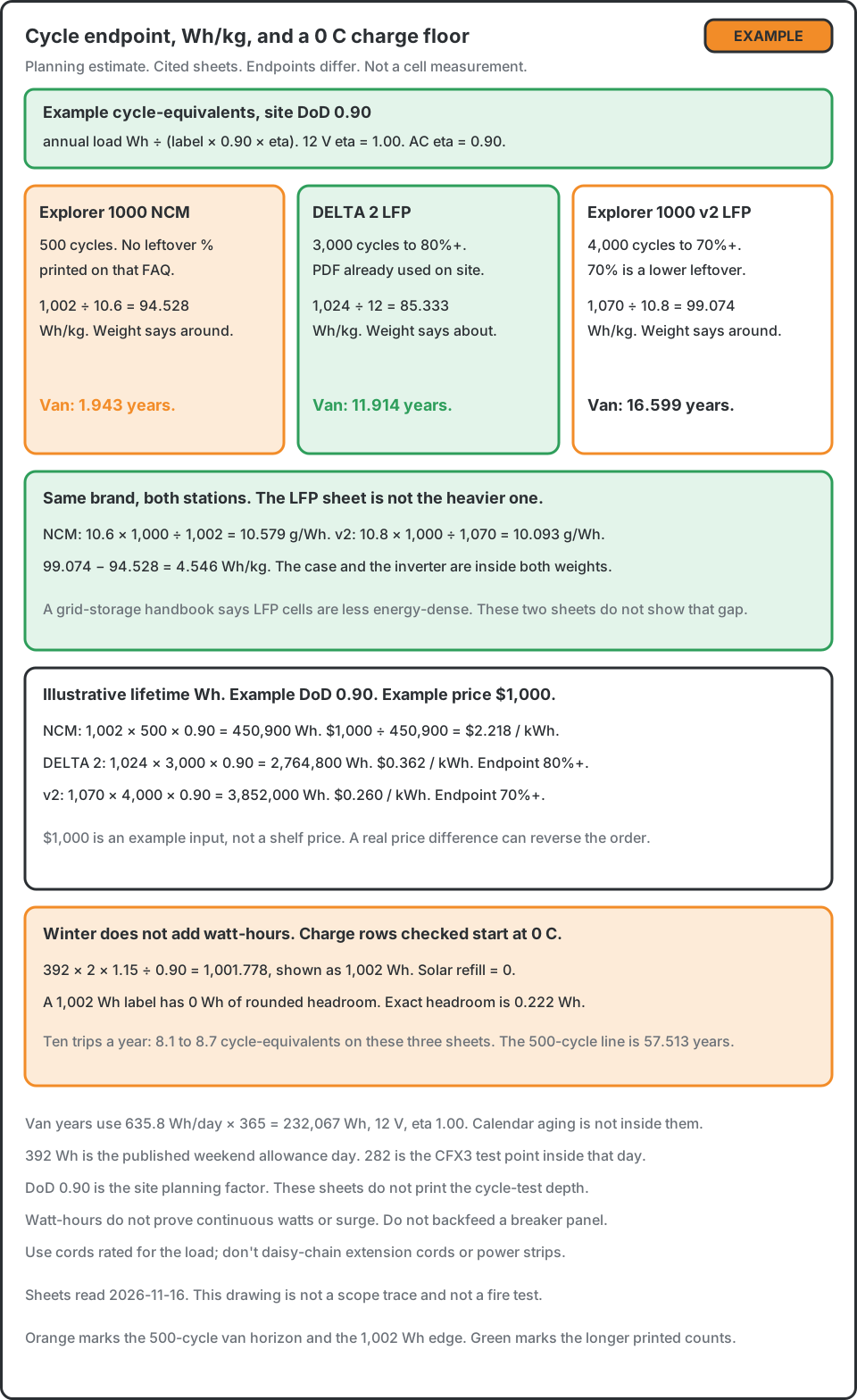
Worked pair, same brand, both stations, about 1 kWh. Explorer 1000 NCM and Explorer 1000 v2 LFP.
1,002 Wh / 10.6 kg = 94.528301… → 94.528 Wh/kg
10.6 kg × 1,000 / 1,002 Wh = 10.578842… → 10.579 g/Wh
1,070 Wh / 10.8 kg = 99.074074… → 99.074 Wh/kg
10.8 kg × 1,000 / 1,070 Wh = 10.093458… → 10.093 g/Wh
99.074 − 94.528 = 4.546 Wh/kg
The unrounded gap is 4.545772…, which also rounds to 4.546. On these two "around" weights, the LFP station carries more watt-hours per kilogram. The slogan that LiFePO4 is the heavier chemistry does not survive this pair. A handbook sentence further down says LFP cells have lower energy density. The station sheet is the number a buyer can lift.
| Pack | Wh / kg | Shown | g/Wh | Shown |
|---|---|---|---|---|
| Explorer 1000, NCM, station | 1,002 / 10.6 | 94.528 | 10,600 / 1,002 | 10.579 |
| Explorer 1000 v2, LFP, station | 1,070 / 10.8 | 99.074 | 10,800 / 1,070 | 10.093 |
| DELTA 2, LFP, station | 1,024 / 12 | 85.333 | 12,000 / 1,024 | 11.719 |
| SOLIX C1000, LFP, station | 1,056 / 12.9 | 81.860 | 12,900 / 1,056 | 12.216 |
| AC180, LFP, station, manual weight | 1,152 / 16.4 | 70.244 | 16,400 / 1,152 | 14.236 |
| DELTA Max extra battery, NCM, no inverter | 2,016 / 18 | 112 | 18,000 / 2,016 | 8.929 |
12 × 85.333… is 1,024 exactly, so 85.333 is the three-decimal display of a repeating quotient. 2,016 / 18 = 112 exactly, and the manual still says the 18 kg is approximate. 11.71875 rounds to 11.719. 12.215909… rounds to 12.216. 14.236111… rounds to 14.236. Sorting this table by Wh/kg does not sort it by chemistry. The lightest station per watt-hour in the list is the LFP v2. The heaviest station per watt-hour is also LFP. The NCM extra battery looks dense because the inverter is not in the 18 kg.
Charging below 0°C
Every charge-temperature row checked on 2026-11-16 starts at 0°C (32°F). Discharge is allowed below that on the same sheets. A winter morning can be inside the discharge row and outside the charge row. The pack can run a load it already holds. Solar and the alternator do not refill it while the battery temperature is below the charge floor. Jackery's usage precautions say: do not charge below 0°C / 32°F. That sentence matches the model rows below. The same precautions page gives one family range for "NCM lithium battery" products and another for "LiFePO4 battery" products. Where a model FAQ prints its own range, this page uses the model row.
| Sheet | Charge | Discharge | What the cold band means |
|---|---|---|---|
| DELTA 2 manual | 0°C to 45°C (32°F to 113°F) | −10°C to 45°C (14°F to 113°F) | Spec floor for charge is 0°C. The troubleshooting sheet says low-temperature charging protection resumes once the battery rises above 5°C (41°F). Discharge protection on that sheet resumes above −12°C (10°F). The resume points are not the spec edges. Both documents stay. A pack between 0°C and 5°C is inside the spec charge range and can still be blocked. |
| Explorer 1000 NCM FAQ | 0°C to 40°C | −10°C to 40°C | Same 0°C charge floor as the LFP v2. The top of the range is 40°C here and 45°C on the v2. |
| Explorer 1000 v2 FAQ | 0°C to 45°C | −10°C to 45°C | LiFePO4 on this FAQ does not open a charge window below 0°C. |
| SOLIX C1000 US page | 32°F to 104°F | −4°F to 104°F | The page prints Fahrenheit. 32°F is 0°C. (104 − 32) / 1.8 = 40, so 104°F is 40°C. (−4 − 32) / 1.8 = −20, so −4°F is −20°C. The Celsius figures are that conversion. |
| AC180 | Manual spec row and product page: 0°C to 40°C (32°F to 104°F). FAQ Q10: avoid recharging below freezing, and prints the same 0°C to 40°C charge range. | Manual spec row and product page: −20°C to 40°C (−4°F to 104°F), with a power cap in the hot end of that range. | The manual's storage-and-usage bullet also says the unit can be safely charged and discharged from −20°C to 40°C. That bullet disagrees with the charging-temperature row and with FAQ Q10. This page follows the charging-temperature row and Q10. Do not charge it below 0°C on the strength of that bullet. |
| DELTA Max NCM extra battery | 0°C to 45°C (32°F to 113°F) | −20°C to 45°C (−4°F to 113°F) | The charge floor matches DELTA 2. The discharge floor is colder than DELTA 2's −10°C. That is this pack's row. It is not a rule that NCM discharges colder than LFP. AC180, which is LFP, also prints −20°C on discharge. |
Each manual adds the same kind of footnote: whether the product can charge or discharge depends on the battery pack's actual temperature, not the air temperature you feel. A pack that sat in a freezing van is not at cabin temperature the moment you bring it inside.
Thermal stability, stated narrowly
Both chemistries in the table are lithium-ion. The DELTA 2 manual and the NCM extra-battery manual each list over-temperature protection and low-temperature protection. That is a BMS line. It is not a measurement of a fire.
The U.S. Department of Energy's energy-storage handbook, Chapter 3, Lithium-Ion Batteries (Sandia, Preger, Torres-Castro, McDowall), is about grid storage cells, not a camping station. It says LFP has a lower average potential than other common positive electrodes, and a correspondingly lower energy density. It says LFP is more thermally stable because, unlike the metal-oxide bond in most other positive electrodes, the phosphorus-oxygen bond is strong and oxygen does not evolve during degradation. It also says NMC energy density goes up, and safety goes down, as nickel content goes up. These sheets do not print a nickel fraction, so this page does not sort the NCM packs into NMC 111 or NMC 811.
That is the sourced difference. It is a reason LFP shows up on the newer station sheets. It is not a prediction that an NCM pack fails on a normal camp trip, and it is not permission to crush, puncture, or charge a damaged LFP pack. The DELTA 2 troubleshooting sheet says that if an alarm stays on after a restart, stop using the unit and do not try to charge or discharge it. No repair steps are copied here. Watt-hours do not measure that alarm.
Storage and self-discharge
The handbook lists low self-discharge as a lithium-ion trait. It does not print an LFP percent and an NMC percent. Two Jackery FAQ rows do print a percent. They are separate from the standby-watt rows. EcoFlow's manuals checked here print a maintenance routine and do not print a percent per month. No percent is invented for them.
| Sheet | What it prints for storage |
|---|---|
| Explorer 1000 NCM FAQ | Self-discharge when not in use: around 5% per month. Storage temperature 0°C to 40°C. Standby power, a different row: 10 W to 15 W. |
| Explorer 1000 v2 FAQ | Self-discharge when not in use: around 1% to 3% per month. Storage: 1 month at −20°C to 45°C, 3 months at 0°C to 45°C, 1 year at 0°C to 25°C. Standby, a different row: 18 W. |
| DELTA 2 manual | For long-term storage, discharge to 30% and recharge to 60% every three months. Store ideally at 20°C to 30°C. Do not store above 45°C or below −10°C for an extended period. No percent per month. |
| DELTA Max NCM extra battery | Spec table: shelf life 1 year after a full charge. Storage range on that table: −20°C to 45°C. The maintenance section says discharge to 30% and recharge to 60% every three months, and says not to store below 14°F (−10°C) for a long time. The 14°F warning and the −20°C spec range are both in the manual. The 1-year shelf line does not replace the three-month routine. No percent per month. |
| AC180 | Manual: if unused more than 3 months, charge to 40% to 60% state of charge and store it powered off. The same note says to discharge and charge it every 3 months for battery life, and the storage section says to fully cycle it every 6 months. Product-page battery block: recharge to 40%-60% every 3-6 months. No percent per month. |
| SOLIX C1000 US page, FAQ | Turn outputs off. Check each week. If the level is below 30%, charge to 100%. Fully charge once every 3 months. No percent per month. |
One month of the Explorer 1000 figure, taken as 5% of the 1,002 Wh nameplate. The FAQ says "around" and does not say whether a second month applies the percent to what remains. This page does not chain the months.
1,002 × 0.05 = 50.1 Wh in that month
1,070 × 0.01 = 10.7 Wh, and 1,070 × 0.03 = 32.1 Wh
Those are the v2 band on the same reading of the FAQ. 50.1 Wh is 50.1 / 870 = 0.057586…, shown as 0.058 of the 870 Wh home-outage day below. The top of the v2 band is 32.1 / 870 = 0.036897…, shown as 0.037 of that day. The bottom is 10.7 / 870 = 0.012299…, shown as 0.012.
Standby is a different row. 10 W × 24 h = 240 Wh. 15 W × 24 h = 360 Wh. 240 / 50.1 = 4.790419…, shown as 4.790. One day at the low end of the NCM standby row moves 4.790 times the FAQ's one-month self-discharge figure. Leave the standby watts out of the 5% line. The storage instructions are for a unit that is off.
DELTA 2's three-month routine, read as a discharge to 30% and a recharge back to 60%, moves 30 percent of the nameplate on the recharge:
1,024 × 0.30 = 307.2 Wh per visit
307.2 × 4 = 1,228.8 Wh per year of those recharges
That 1,228.8 Wh is maintenance throughput. It is not a measured self-discharge, and it is not subtracted from the 3,000-cycle line.
Illustrative cost per lifetime watt-hour
The manuals do not print a price. A shelf price seen on a product page during this read is not copied. The formula uses one example price so the denominator is the only thing that changes. The example price is $1,000. It is an input to the formula. It is not a claim about what any of these units cost.
illustrative $ per lifetime Wh = example price / (nameplate Wh × printed cycles × example DoD)
Example DoD is 0.90, the site planning factor. The sheets do not print the depth used in the cycle test. The AC180 manual's own runtime example says that unit works at 90% depth of discharge, then multiplies by 85% and adds about 15 W of self-consumption. This page does not use that runtime shortcut. The 0.90 here is not a statement that EcoFlow or Jackery cycled to 90%.
Dollars per kWh below are the per-Wh result times 1,000, then half-up to three decimals. Endpoints stay in the row. These dollars are not a ranking.
| Sheet | Wh × cycles × 0.90 | Lifetime Wh | $1,000 / lifetime Wh, per kWh |
|---|---|---|---|
| Explorer 1000, 500 cycles, no leftover percent | 1,002 × 500 × 0.90 | 450,900 | 0.002217787 → $2.218 |
| NCM extra battery, 800 cycles to 80%+ | 2,016 × 800 × 0.90 | 1,451,520 | 0.000688933 → $0.689 |
| DELTA 2, 3,000 cycles to 80%+ | 1,024 × 3,000 × 0.90 | 2,764,800 | 0.000361690 → $0.362 |
| SOLIX C1000, 3,000 cycles to 80%+ | 1,056 × 3,000 × 0.90 | 2,851,200 | 0.000350730 → $0.351 |
| AC180, 3,500 of the printed 3,500+, to 80% | 1,152 × 3,500 × 0.90 | 3,628,800 | 0.000275573 → $0.276 |
| Explorer 1000 v2, 4,000 cycles to 70%+ | 1,070 × 4,000 × 0.90 | 3,852,000 | 0.000259605 → $0.260 |
Hold the example price fixed and the printed cycle count dominates the denominator. A real price ratio larger than the lifetime-Wh ratio would flip the order. The v2 row stops at 70%+, so its $0.260 is not the same test as a row that stops at 80%+. The 500-cycle row has no leftover percent, so its $2.218 is not "the cost of NCM" as a chemistry. It is this formula on that FAQ's count.
Weekend camper, 10 trips a year
Solar = 0. The day is the weekend allowance already used on under ~500 Wh: the CFX3 35 test point, 282 Wh, plus 50 Wh of lamps and 60 Wh of phone charging. 282 + 50 + 60 = 392 Wh at the loads, on 12 V and USB, η = 1.00. This page's trip is two of those days. Ten trips is this page's year. It is not a survey of how often people camp.
392 × 2 × 1.15 / 0.90 = 1,001.777… → 1,002 Wh
Steps: 784 Wh at the loads, × 1.15 = 901.6, ÷ 0.90 = 1,001.777…. One day is 392 × 1.15 / 0.90 = 500.889 → 501 Wh, the same one-day nameplate as the under-500 page. Annual energy at the loads: 392 × 2 × 10 = 7,840 Wh.
| Label | Cycle-equivalents / year | Years to the printed count | Two-day plan, 1,002 Wh |
|---|---|---|---|
| 1,002 Wh, 500 cycles | 7,840 / 901.8 = 8.693724 → 8.694 | 500 × 1,002 × 0.90 / 7,840 = 57.512755 → 57.513 | Rounded headroom 0. Exact headroom 1,002 − 1,001.778 = 0.222 Wh. |
| 1,024 Wh, 3,000 to 80%+ | 7,840 / 921.6 = 8.506944 → 8.507 | 352.653 | Headroom 1,024 − 1,002 = 22 Wh. |
| 1,070 Wh, 4,000 to 70%+ | 7,840 / 963 = 8.141225 → 8.141 | 491.327 | Headroom 68 Wh. |
| 1,056 Wh, 3,000 to 80%+ | 7,840 / 950.4 = 8.249158 → 8.249 | 363.673 | Headroom 54 Wh. |
| 1,152 Wh, 3,500 to 80% | 7,840 / 1,036.8 = 7.561728 → 7.562 | 462.857 | Headroom 150 Wh. |
Unbuffered runtime on the 1,002 Wh label: 901.8 / 392 = 2.300510… days, shown as 2.301 days. Hours use that unrounded quotient: (901.8 / 392) × 24 = 55.212245…, shown as 55.212 hours. 2.301 × 24 = 55.224 is the rejected chain. The unbuffered energy covers the two-day load of 784 Wh, because 901.8 is above 784. The buffer is what puts the shopping number on top of the label. A 512 Wh sheet delivers 460.8 Wh on 12 V. 460.8 is short of 784 by 323.2 Wh, and 512 is short of the 1,002 Wh plan by 490 Wh. Chemistry does not close that gap. At ten trips a year, the 500-cycle line is 57.513 years if calendar aging is zero and if each example cycle really is 90% of the label. The binding check is the 1,002 Wh nameplate, not the cathode name.
Full-time van, one day every day
The mild parked day on van daily Wh is 635.8 Wh, all on 12 V or USB in that guide: CFX3 test point 282, fan 25.2, four pucks 44, two phones 40, one laptop recharge 52.6, router ceiling 192. 282 + 25.2 + 44 + 40 + 52.6 + 192 = 635.8. Solar = 0. This page's year is 365 of those days, recharged from shore or from driving, with no alternator watt-hours subtracted. One discharge of the day's load is the assumption. It is not a logbook.
635.8 × 1.15 / 0.90 = 812.41111… → 812 Wh
635.8 × 365 = 232,067 Wh per year at the loads
| Label | Cycle-equivalents / year | Years to the printed count | One-day plan, 812 Wh | Unbuffered days |
|---|---|---|---|---|
| 1,002 Wh, 500 cycles | 232,067 / 901.8 = 257.337547 → 257.338 | 1.943 | Headroom 1,002 − 812 = 190 Wh | 901.8 / 635.8 = 1.418371 → 1.418 |
| 1,024 Wh, 3,000 to 80%+ | 232,067 / 921.6 = 251.808811 → 251.809 | 11.914 | Headroom 212 Wh | 921.6 / 635.8 = 1.449512 → 1.450 |
| 1,070 Wh, 4,000 to 70%+ | 232,067 / 963 = 240.983385 → 240.983 | 16.599 | Headroom 258 Wh | 963 / 635.8 = 1.514627 → 1.515 |
Hours on the 1,002 Wh label: (901.8 / 635.8) × 24 = 34.040893…, shown as 34.041 hours. 1.418 × 24 = 34.032 is rejected. On the v2 label, (963 / 635.8) × 24 = 36.351054…, shown as 36.351 hours. On DELTA 2, (921.6 / 635.8) × 24 = 34.788298…, shown as 34.788 hours.
Today's shopping number is 812 Wh on every row. A 1,002 Wh NCM label covers that day with 190 Wh of label left. The chemistry shows up in the year column. At one of these days, every day, the 500-cycle line is 1.943 years. The 3,000-cycle line to 80%+ is 11.914 years. The 4,000-cycle line to 70%+ is 16.599 years. Those years assume the example depth, a full 365 days, and no calendar aging. They are why a full-time van is the use where the printed cycle count changes the buy, and why the leftover percent still has to sit in the same sentence as the count.
If that same 635.8 Wh moved onto AC outlets, η becomes 0.90 and the divider becomes 0.81. The nameplate is 635.8 × 1.15 / 0.81 = 902.679 → 903 Wh, the van guide's all-AC day. On the 1,002 Wh label the full year quotient is 500 × 1,002 × 0.81 / 232,067 = 1.748676…, shown as 1.749 years. Multiplying the already-rounded 1.943 by 0.81 / 0.90 also lands on 1.749. Size from the full quotient. The van guide keeps this day on 12 V. The AC line is here so η = 1.00 stays on the 12 V path.
Home backup, mostly in storage
Scenario A on home outage, AC plugs only. Router 20 W × 24 h = 480 Wh. Lamps 40 W × 6 h = 240 Wh. Phones and laptops allowance 150 Wh. Total 870 Wh/day. One buffered day is 870 × 1.15 / 0.81 = 1,235.185185… → 1,235 Wh. This page's assumption is two such outage days in a year. That is not a utility statistic. Annual energy at the loads is 870 × 2 = 1,740 Wh. Battery-side draw, because η = 0.90, is 1,740 / 0.90 = 1,933.333 Wh.
| Label | One-day plan, 1,235 Wh | Cycle-equivalents in two outage days | Years to the printed count |
|---|---|---|---|
| 1,002 Wh, 500 cycles | Short by 233 Wh | 1,740 / 811.62 = 2.143860 → 2.144 | 233.224 |
| 1,024 Wh, 3,000 to 80%+ | Short by 211 Wh | 1,740 / 829.44 = 2.097801 → 2.098 | 1,430.069 |
| 1,056 Wh, 3,000 to 80%+ | Short by 179 Wh | 1,740 / 855.36 = 2.034231 → 2.034 | 1,474.759 |
| 1,070 Wh, 4,000 to 70%+ | Short by 165 Wh | 1,740 / 866.7 = 2.007615 → 2.008 | 1,992.414 |
| 1,152 Wh, 3,500 to 80% | Short by 83 Wh | 1,740 / 933.12 = 1.864712 → 1.865 | 1,876.966 |
Every label in that table misses one buffered outage day. The cycle-year column is hundreds or thousands of years, and the unit still does not hold the day. Chemistry does not shrink 1,235 Wh. The ~1,000 Wh class is the wrong class for this stack. That result is already on the home-outage guide and on the ~2,000 Wh page.
What does change in a closet is the storage line. Four DELTA 2 maintenance recharges move 1,228.8 Wh in a year, from the section above, against 1,933.333 Wh of battery draw in the two outage days. The maintenance visits are the same order of magnitude as the outages in this assumption. The Explorer 1000's around-5%-per-month line is 50.1 Wh in one month, which is real energy to plan to replace, and it is still smaller than one day of the 10 W standby row. The NCM extra battery's "1 year after a full charge" is a shelf line next to a three-month 30%-to-60% routine. Read both. Do not turn the shelf line into a date the pack becomes unsafe, and do not skip the three-month routine because the cycle count is 800.
Winter camping, charge floor in force
Same two camp days as the weekend section. 392 Wh/day, 12 V, η = 1.00, solar charge unavailable because the pack is below the charge-temperature row. That is this page's winter assumption for a morning in the band these sheets describe: cold enough that charging is outside the row, and, for a DELTA 2, not yet above the 5°C resume line. It is not a weather-service record.
392 × 2 × 1.15 / 0.90 = 1,001.778 → 1,002 Wh
Refill during that stretch is 0 Wh. You arrive with the two days already stored. A 1,002 Wh label meets the rounded plan with 0.222 Wh of exact headroom. A 1,024 Wh label covers it by 22 Wh. A 512 Wh label misses it by 490 Wh. Discharge can continue when the air is below 0°C and the pack is still inside the discharge row: −10°C on DELTA 2 and on both Explorer 1000 FAQs, −20°C on the AC180 discharge row and on the NCM extra battery. Below the discharge row, the sheet does not offer a runtime. The chemistry does not move the charge floor below 0°C on any row checked here. Jackery's LFP v2 and Jackery's NCM Explorer 1000 share that floor. The LFP v2's wider range is at the hot end, 45°C instead of 40°C, which is not the winter problem.
Size the cold stretch the way the rainy-weekend guide sizes a dark stretch. Keep the full load. Set days to the stretch you cannot recharge. Then read the charge row before you count on the solar input watts.
Where the chemistry changes the buy
| Use | What the chemistry line changes | What it does not change |
|---|---|---|
| 10 camp trips a year, 392 Wh/day, two days, 12 V | About 7.6 to 8.7 cycle-equivalents a year. The 500-cycle line is still 57.513 years if calendar aging is zero. | The buffered trip is 1,002 Wh. A 1,002 Wh label has no rounded headroom. A 512 Wh label misses by 490 Wh. |
| Van, 635.8 Wh every day, 12 V | 1.943 years on 500 cycles, 11.914 years on 3,000 to 80%+, 16.599 years on 4,000 to 70%+. The leftover percent stays attached to the count. | Today's nameplate is 812 Wh. The 1,002 Wh label covers that day. |
| Home backup, 870 Wh/day AC, two days in the year | Storage routine, and the only printed self-discharge percents, which are Jackery's. Cycle years run to hundreds or thousands. | One day names to 1,235 Wh. The ~1 kWh labels in the table miss it. |
| Winter, pack below the charge row | Nothing in the charge floor. Every charge row checked starts at 0°C. DELTA 2's troubleshooting sheet waits until above 5°C. | Two days still name to 1,002 Wh. Refill is 0 Wh until the pack is back inside the charge row. Discharge follows the discharge row. |
Carry weight is a separate check from Wh/kg. A 10.6 kg station and a 16.4 kg station are different lifts even when both can hold the 812 Wh van day. Divide the printed watt-hours by the printed kilograms before treating the cathode name as the weight.
Sources
- EcoFlow DELTA 2 user manual — LFP, 3,000 cycles to 80%+, 1,024 Wh, about 12 kg, charge 0°C to 45°C, discharge −10°C to 45°C, storage 30% to 60% every three months.
- EcoFlow DELTA 2 troubleshooting — low-temperature charge resumes above 5°C. Low-temperature discharge resumes above −12°C.
- EcoFlow DELTA Max Smart Extra Battery manual — NCM, 2,016 Wh, about 18 kg, 800 cycles to 80%+, shelf life 1 year after a full charge, charge 0°C to 45°C.
- Jackery Explorer 1000 basic information — NCM, 1,002 Wh, around 10.6 kg, 500 cycles, charge 0°C to 40°C, self-discharge around 5% per month. Updated 2026-08-19.
- Jackery Explorer 1000 v2 basic information — LiFePO4, 1,070 Wh, around 10.8 kg, 4,000 cycles ≥70%, charge 0°C to 45°C, self-discharge around 1% to 3% per month. Updated 2026-10-15.
- Jackery usage precautions — do not charge below 0°C / 32°F.
- Anker SOLIX C1000 / C1000X — LiFePO4, 1,056 Wh, 12.9 kg, 3,000 cycles to 80%+, charge 32°F to 104°F, discharge −4°F to 104°F. Weekly check and a three-month full charge are in the FAQ.
- Anker service introduction, SOLIX C1000 — 1,056 Wh, 12.9 kg, the same Fahrenheit charge and discharge lines. This introduction does not print the cycle count.
- BLUETTI AC180 product page — 3,500+ cycles to 80% original capacity, charge 0°C to 40°C, FAQ Q10 on sub-zero recharging. A price on that page is not used.
- BLUETTI AC180 manual — 1,152 Wh, LiFePO4, about 16.4 kg, charging-temperature row 0°C to 40°C, and the storage bullet that disagrees with that row.
- DOE energy-storage handbook, Chapter 3, Lithium-Ion Batteries — LFP energy density and thermal-stability sentences for grid-storage cells. Not a station test.
The 392 Wh day, the 635.8 Wh van day, and the 870 Wh outage day are the figures already published on under ~500 Wh, van life, and home outage. This page does not re-measure them.
Related: EcoFlow vs Jackery vs Bluetti · under ~500 Wh · ~1,000 Wh · ~2,000 Wh · weekend camping · van daily Wh · home outage · solar vs battery · surge traps
Wh calculator — one η per pass. 12 V and USB: set inverter efficiency to 1.00. AC outlets: leave η at 0.90. nameplate = (Wh/day × days × 1.15) / (0.90 × η).
Where to check pricing
As an Amazon Associate, we earn from qualifying purchases at no extra cost to you. EcoFlow, Jackery, and Bluetti partner programs are not live yet. This page does not print a shelf price. The $1,000 figure above is an example input to the lifetime formula.
Jackery — Coming soon EcoFlow — Coming soon Bluetti — Coming soon