Large ~2000 Wh+ class
Results from 1,153 Wh up land in this class. The class has no ceiling. A round 2,000 Wh label delivers 1,800 Wh on 12 V and 1,620 Wh on AC. One cited fridge sticker day names to 1,688 Wh and fits that label. The same fridge, a router left on for 24 h, and a slim CPAP night name to 2,047 Wh and miss it by 47 Wh. A printed 2,048 Wh sheet covers that 2,047 Wh plan by 1 Wh. Sheets below were read 2026-11-13, except the station lines carried from the earlier extract of the same manual.
What a label in this class delivers
Same order as js/calculator.js. Round the full quotient once, half-up, the way Math.round does. Do not round the middle steps and then keep going. DoD=0.90 is a planning fraction of the label. It is not a BMS guarantee. The 15% buffer is headroom, not a measured loss. The runtime check does not apply the buffer again on the way down.
2,000 Wh is a round planning label. It is not a claim that a box is printed that way. The DELTA 2 Max manual prints 2,048 Wh. That sheet is already the ~2,000 Wh example on 1,000 vs 2,000 Wh. It is one manual in this watt-hour band. It is not a ranking. Do not shop the sheet’s delivered watt-hours as if they were the round 2,000 label. The step down, where a 1,000 Wh label still covers a weekend, is mid ~1,000 Wh.
| Label | 12 V / USB delivered | AC delivered |
|---|---|---|
| 2,000 Wh, round | 2,000 × 0.90 = 1,800 Wh | 2,000 × 0.81 = 1,620 Wh |
| 2,048 Wh, printed sheet | 2,048 × 0.90 = 1,843.2 → 1,843 Wh | 2,048 × 0.81 = 1,658.88 → 1,659 Wh |
The 1,800 and 1,620 products are exact. 1,843.2 and 1,658.88 are the unrounded sheet products. Round those once for the display. Runtime on the sheet divides 1,843.2 or 1,658.88, not 1,843 or 1,659. The 1,659 Wh AC figure is the same product already on EcoFlow vs Jackery vs Bluetti. Do not shop 1,659 Wh as if it were the round label’s 1,620 Wh, or 1,843 Wh as if it were 1,800 Wh.
Class spans on this site, from the sizing walkthrough: results up to 512 Wh, then 513–1,152 Wh, then 1,153 Wh and up. “Inside this class” means the rounded nameplate is at least 1,153 Wh. It does not mean a round 2,000 Wh label covers it. Shop the buffered nameplate against the printed label. A plan of 935 Wh is still the ~1,000 Wh class. A plan of 1,688 Wh is this class, and it still sits under a 2,000 Wh label.
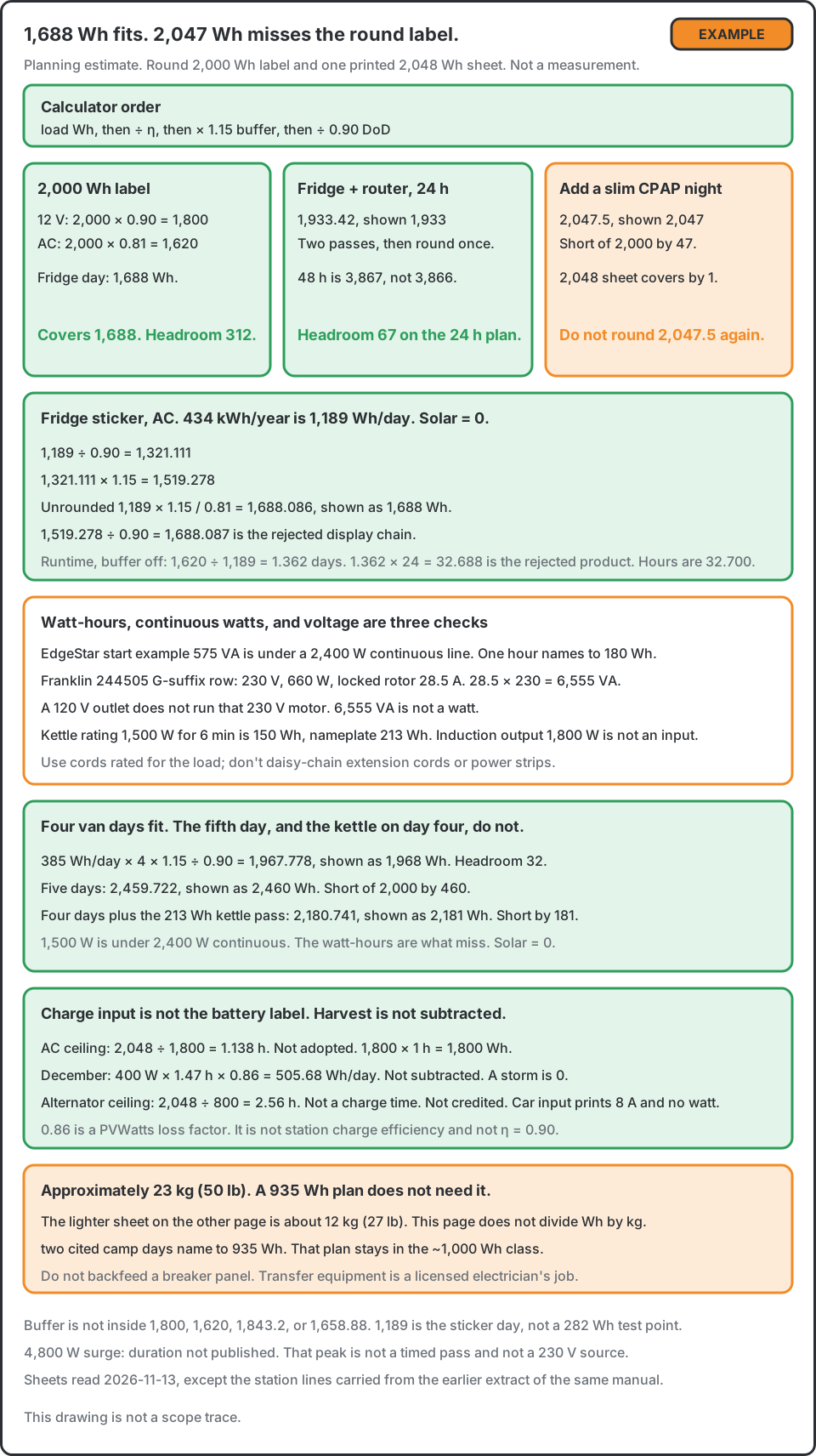
One fridge sticker day, then two
Solar = 0. This is the full-size kitchen fridge already on home outage and on 1,000 vs 2,000 Wh. It is not the CFX3 282 Wh/day test point. Two of those camping days name to 935 Wh and stay in the mid class.
The public GE EnergyGuide for models GTS21FGK, GTS21FTK, GTS21FMK, and GTS21FSK prints 434 kWh estimated yearly electricity use. 434 × 1,000 / 365 = 1,189.041, published as 1,189 Wh/day. 1,189 / 24 = 49.542 W average, shown on the other pages as about 49.5 W. That average includes hours the compressor is off. It is not running watts and not a start surge. The dollars on the label are not used. The house fridge plugs into AC. Leave η at 0.90.
Steps for one day, each figure the three-decimal display of the unrounded product: 1,189 ÷ 0.90 = 1,321.111. × 1.15 = 1,519.278. The nameplate divides the unrounded product, 1,688.086. Do not divide the 1,519.278 display. 1,519.278 / 0.90 = 1,688.087.
| Plan, solar = 0 | Steps | Exact | Nameplate |
|---|---|---|---|
| Fridge, 1 day, AC | 1,189.000 → 1,321.111 → 1,519.278 → nameplate | 1,688.086 | 1,688 Wh |
| Fridge, 2 days, AC | 2,378 on the same path. Do not double 1,688. | 3,376.173 | 3,376 Wh |
1,189 × 1.15 / 0.81 = 1,688.086 → 1,688 Wh
1,189 × 2 × 1.15 / 0.81 = 3,376.173 → 3,376 Wh
A 1,000 Wh label is short of 1,688 by 688 Wh. A 2,000 Wh label covers it. Headroom is 2,000 − 1,688 = 312 Wh. A 2,048 Wh sheet covers it. Headroom is 2,048 − 1,688 = 360 Wh. Two sticker days name to 3,376 Wh. The round label is short by 1,376 Wh. The sheet is short by 3,376 − 2,048 = 1,328 Wh. One cited fridge day is where a 2,000 Wh label earns the watt-hours. A second fridge day is past both labels. 1,688 × 2 = 3,376, which happens to match. Size from the two-day quotient anyway.
Runtime, buffer off. A 2,000 Wh label delivers 1,620 Wh on AC: 1,620 / 1,189 = 1.362 days, and (1,620 / 1,189) × 24 = 32.700 hours at the sticker-day average. Do not multiply the rounded day: 1.362 × 24 = 32.688. A 1,000 Wh label delivers 810 Wh: 810 / 1,189 = 0.681 day, and (810 / 1,189) × 24 = 16.350 hours. 0.681 × 24 = 16.344. On the sheet, divide the unrounded product: 1,658.88 / 1,189 = 1.395 days. Do not divide 1,659. The runtime of 1.362 days is not two sticker days. The buffered one-day plan is what the label covers. The buffered two-day plan is what it misses.
The GTS21 owner’s manual (49-60761, 01-17 GEA) requires a 115 V AC, 60 Hz, 15- or 20-amp grounded supply, and its shock warning says not to use an extension cord. The manual does not print compressor running watts or a locked-rotor amp. This page does not multiply 15 A or 20 A by 115 V and call the product the fridge. No surge multiple is invented here. No scope trace. A 2,000 Wh label that covers 1,688 Wh of sticker energy does not prove the compressor starts. Read the fridge rating plate. If the station cannot sit at the fridge, that is an electrician and a transfer switch or interlock, not a backfeed into the panel.
24 h and 48 h: fridge, router, and CPAP
Solar = 0. The fridge is the same 1,189 Wh sticker day, counted once, not halved. The router window on this day is 24 h, because the row is a calendar day. The CPAP window stays 8 h. Those windows are one planning day. They are not a flat 24 h draw on every device. The lamp row on 1,000 vs 2,000 Wh is a different sum. That page’s 2,682 Wh includes 102 Wh of lamps. This page does not. Do not subtract 145 from 2,682 and call it this day.
The router is the GL.iNet GL-MT3000. The product page prints power consumption as <8 W. Ceiling for this day: 8 W × 24 h = 192 Wh. The 12 h ceiling on the mid-class page is 96 Wh. It is not this row. The CPAP figures are the AirSense 10 rows already on CPAP, from ResMed’s battery guide (198103/7, 2018-08). A fetch of that PDF on 2026-11-13 returned HTTP 403, so the amps were not re-extracted. The worked pressure is the printed 10 cm H2O column. It is not a recommended setting. This page does not set pressure, humidity, or tube heat. Watt-hours are the printed current × 12 V × 8 h.
| Load | Basis | Wh | Path |
|---|---|---|---|
| Fridge sticker | 434 kWh/year → 1,189 Wh/day. One outage day. | 1,189 | AC, η=0.90 |
| GL-MT3000 | Ceiling 8 W × 24 h. The page prints <8 W. | 192 | USB, η=1.00 |
| SlimLine only | 0.93 A × 12 V × 8 h. | 89.28 | DC converter, η=1.00 |
| ClimateLineAir at 30°C, humidifier setting 8 | 4.92 A × 12 V × 8 h. The heavy row. | 472.32 | DC converter, η=1.00 |
| Fridge + router | 1,189 on AC, 192 on USB. | 1,381 | Two passes |
| Slim day | 192 + 89.28 = 281.28 on the DC convention, plus the fridge. | 1,470.28 | Two passes |
| Heavy day | The page uses the literal 664.32 for 192 + 472.32, plus the fridge. | 1,853.32 | Two passes |
ResMed’s guide recommends a DC-to-DC converter. Its inverter steps name other ResMed machines and only the HumidAire 2i, H4i, and H5i humidifiers. They do not name AirSense 10 with HumidAir. The same section warns: “Other ResMed heated humidifiers must not be used with inverters. Damage to the unit or serious injury to the user may result.” A station’s AC outlet is an inverter. The rows below keep the CPAP on the DC converter. This page does not publish an AC nameplate for that heated humidifier. The figures are not a setup and not an approval. Where that guide does allow an inverter, it asks for pure sine wave, 300 W continuous and 500 W peak. Check your device manual and the label on your power brick for your exact model.
Fridge plus router, two passes. AC: 1,189 × 1.15 / 0.81 = 1,688.086. DC: 192 × 1.15 / 0.90 = 245.333. The displays add to 1,688.086 + 245.333 = 1,933.419, one thousandth under the full sum’s 1,933.420. The full sum rounds to 1,933 Wh. Rounded passes are 1,688 + 245 = 1,933. Size from the full sum anyway. Two days: the displays add to 3,376.173 + 490.667 = 3,866.840, which matches the full sum’s three-decimal figure. The full sum rounds to 3,867 Wh. Rounded passes are 3,376 + 491 = 3,867. Do not double the rounded day. 1,933 × 2 = 3,866.
1,189 × 1.15 / 0.81 + 192 × 1.15 / 0.90 = 1,688.086 + 245.333… = 1,933.420 → 1,933 Wh
1,189 × 2 × 1.15 / 0.81 + 192 × 2 × 1.15 / 0.90 = 3,866.840 → 3,867 Wh
A 2,000 Wh label covers the 24 h plan. Headroom is 2,000 − 1,933 = 67 Wh. A 2,048 Wh sheet covers it. Headroom is 2,048 − 1,933 = 115 Wh. A 1,000 Wh label is short by 933 Wh. Forty-eight hours name to 3,867 Wh. Both labels are short. The round label is short by 1,867 Wh. The sheet is short by 3,867 − 2,048 = 1,819 Wh.
Battery draw before buffer and DoD: 192 + 1,189 / 0.90 = 192 + 1,321.111 = 1,513.111 Wh. A 2,000 Wh label covers (2,000 × 0.90) / 1,513.111 = 1.190 days. Hours at that day’s average are (1,800 / 1,513.111) × 24 = 28.550. Do not multiply the rounded day: 1.190 × 24 = 28.560. On the sheet, 1,843.2 / 1,513.111 = 1.218 days, and (1,843.2 / 1,513.111) × 24 = 29.236 hours. 1.218 × 24 = 29.232. Do not divide 1,843. The unbuffered energy covers one of these days. The buffered 1,933 Wh plan is what the 2,000 Wh label also covers.
Add the slim CPAP night. DC load is 281.28 Wh. Steps: 281.280 → 323.472 → 359.413. AC stays 1,688.086. The displays add to 1,688.086 + 359.413 = 2,047.499, one thousandth under the full sum’s 2,047.500. The full sum rounds to 2,047 Wh. Rounded passes are 1,688 + 359 = 2,047. Math.round of the three-decimal display 2,047.5 is 2,048. Do not round the display again. Shop 2,047.
1,189 × 1.15 / 0.81 + 281.28 × 1.15 / 0.90 = 1,688.086 + 359.413 = 2,047.500 → 2,047 Wh
Same stack × 2 = 4,094.9995, three-decimal display 4,095 → 4,095 Wh
A round 2,000 Wh label is short of 2,047 by 47 Wh. A 2,048 Wh sheet covers 2,047 because 2,048 ≥ 2,047. Headroom on the rounded nameplate is 1 Wh. Two slim days name to 4,095 Wh. Do not double the rounded day. 2,047 × 2 = 4,094. Both labels are short of 4,095. The sheet is short by 4,095 − 2,048 = 2,047 Wh.
Battery draw: 281.28 + 1,189 / 0.90 = 1,602.391 Wh. A 2,000 Wh label covers 1,800 / 1,602.391 = 1.123 days, and (1,800 / 1,602.391) × 24 = 26.960 hours. 1.123 × 24 = 26.952. The unbuffered energy covers one slim day. The buffer is what puts the shopping number 47 Wh past the round label. On the sheet, 1,843.2 / 1,602.391 = 1.150 days. Do not divide 1,843. The sheet covers the buffered plan as well.
The heavy night replaces 89.28 Wh with 472.32 Wh. In JavaScript, 192 + 472.32 lands on 664.3199999999999. The pass uses the literal 664.32. Steps: 664.320 → 763.968 → 848.853. Displays add to 1,688.086 + 848.853 = 2,536.939, one thousandth under the full sum’s 2,536.940. The full sum rounds to 2,537 Wh. Rounded passes are 1,688 + 849 = 2,537.
1,189 × 1.15 / 0.81 + 664.32 × 1.15 / 0.90 = 1,688.086 + 848.853 = 2,536.940 → 2,537 Wh
Same stack × 2 = 5,073.88 → 5,074 Wh
A 2,000 Wh label is short of 2,537 by 537 Wh. A 2,048 Wh sheet is short by 2,537 − 2,048 = 489 Wh. Two heavy days name to 5,074 Wh. 2,537 × 2 = 5,074, which happens to match. Size from the two-day quotient anyway. Both labels are short of two days by thousands of watt-hours. Battery draw: 664.32 + 1,321.111 = 1,985.431 Wh. A 2,000 Wh label covers 1,800 / 1,985.431 = 0.907 day, and (1,800 / 1,985.431) × 24 = 21.758 hours. 0.907 × 24 = 21.768. The unbuffered energy is already short of one heavy day. A label that covers the fridge sticker alone does not cover the fridge, the router, and this CPAP night.
Van: four days of fridge, laptop, and fan, then a kettle
Engine off. Solar = 0. The day is the one already on van daily Wh and on 1,000 vs 2,000 Wh. CFX3 35 test point 282 Wh, Caframo high for 12 h at 50.4 Wh, MacBook Air pack floor 52.6 Wh. All DC or USB: 282 + 50.4 + 52.6 = 385 Wh/day. One day names to 492 Wh. Two days name to 984 Wh. A 1,000 Wh label covers both. Three days name to 1,476 Wh, which is this class and still under a 2,000 Wh label. This page counts the fourth and fifth days.
| 385 Wh/day, 12 V, solar = 0 | Load Wh | Exact | Nameplate |
|---|---|---|---|
| 4 days | 1,540. Steps 1,540 → 1,771 → nameplate. | 1,967.778 | 1,968 Wh |
| 5 days | 1,925. Steps 1,925 → 2,213.75 → nameplate. | 2,459.722 | 2,460 Wh |
385 × 4 × 1.15 / 0.90 = 1,967.778 → 1,968 Wh
385 × 5 × 1.15 / 0.90 = 2,459.722 → 2,460 Wh
On this 12 h stack, 492 × 4 = 1,968 and 492 × 5 = 2,460. Those products happen to match the rounded quotients. Size from the quotients anyway. A 2,000 Wh label covers four of these days. Headroom is 2,000 − 1,968 = 32 Wh. A 2,048 Wh sheet covers them. Headroom is 2,048 − 1,968 = 80 Wh. Five days are short of the round label by 460 Wh and short of the sheet by 2,460 − 2,048 = 412 Wh. Runtime, buffer off: 1,800 / 385 = 4.675 days, and (1,800 / 385) × 24 = 112.208 hours. 4.675 × 24 = 112.200. On the sheet, 1,843.2 / 385 = 4.788 days. Do not divide 1,843. Four buffered days fit. The fifth day with no recharge does not.
A kettle is a separate window, not a fourth appliance left on all day. The Hamilton Beach use-and-care for models 41020 and 41022 (type K56) prints, on the Spanish electrical-characteristics line, 120 V ~ 60 Hz 1500 W. The English pages of that PDF, in the text extracted 2026-11-13, do not repeat the watt figure. They do say not to operate another high-wattage appliance on the same circuit. No power factor is printed. This page uses 1,500 W as that printed rating. Six minutes is this page’s window, not a boil time on the sheet. The 900 W Hamilton Beach coffee maker on surge traps is a different appliance.
1,500 W × (6/60) h = 150 Wh
150 × 1.15 / 0.81 = 212.963 → 213 Wh
A 2,000 Wh label delivers 1,620 Wh on AC, which is 1,620 / 150 = 10.800 of those windows. A 2,048 Wh sheet delivers 1,658.88 Wh, 1,658.88 / 150 = 11.059 windows. Do not divide 1,659. Both store one boil. 1,500 W is under the DELTA 2 continuous 1,800 W and under the DELTA 2 Max continuous 2,400 W, for this kettle alone. The surge cells are not what covers a six-minute heater. The watt-hours of one window are 213 Wh. That is under a 300 Wh label. The kettle is not why this class exists.
Stack the window on the van days. DC pass stays the van nameplate. AC pass is 212.963. Four days: 1,967.778 + 212.963 = 2,180.741, which rounds to 2,181 Wh. The displays add to the same 2,180.741. Rounded passes are 1,968 + 213 = 2,181. Three days plus the same window: 1,475.833 + 212.963 = 1,688.796, which rounds to 1,689 Wh. Rounded passes are 1,476 + 213 = 1,689.
385 × 4 × 1.15 / 0.90 + 150 × 1.15 / 0.81 = 1,967.778 + 212.963 = 2,180.741 → 2,181 Wh
A 2,000 Wh label covers three van days plus one kettle window. Headroom is 2,000 − 1,689 = 311 Wh. It is short of four van days plus that window by 2,181 − 2,000 = 181 Wh. The sheet is short of that four-day stack by 2,181 − 2,048 = 133 Wh. Four van days alone still fit. The kettle is 213 Wh of nameplate on top of a plan that had 32 Wh of headroom.
The induction cooktop is a different sheet, and it does not become a watt-hour here. The Duxtop manual for 9600LS and 9610LS prints power source 120 V / 60 Hz, 15 amp circuit, and output 100–1,800 watts. The level-10 cell in the power table is 1,800 in that watts column. The manual says the power level relates to the wattage the cooktop generates. It does not print input watts or a power factor. This page does not treat 1,800 W of output as a wall draw, and it does not multiply it by minutes. 15 × 120 = 1,800 VA. That product equals the top of the output band. It is not a measured input. The manual’s “up to 1,800 watts,” the gas-stove comparison, and the cost-per-hour sentence are not used. A dedicated 15 A outlet is the manual’s note. It is not a pass on a station inverter.
On the DELTA 2 Max sheet, AC output is pure sine, 2,400 W total (surge 4,800 W), 120 V. Duration of that surge cell is not published. That peak is not a timed pass. 1,500 W of kettle rating is under 2,400 W continuous, so this kettle alone does not need the surge cell and does not need the X-Boost line. The sheet’s X-Boost figure is 3,400 W. EcoFlow’s X-Boost page says the feature “marginally reduces voltage”; it gives no volt figure. WattNeeds sizing rule: voltage-reduction lift modes are for resistive heating loads only. Reduced voltage can stall or overheat motor and compressor loads. Not a surge rating. Do not size a fridge, a well motor, or an induction cooktop on it. The kettle is a heater for the whole window, and 2,400 W continuous already covers 1,500 W, so X-Boost stays idle. The Duxtop 1,800 W output is not a reason to turn it on.
Startup watts, then 120 V versus 230 V
Stored energy can pass while the inverter’s continuous line, or the outlet voltage, is a separate check. No surge multiple is invented here. No scope trace. The freezer and the 115 V motor are the worked rows on surge traps. This page asks whether the ~2,000 Wh sheet’s 2,400 W line changes them, and what a 230 V nameplate does to that question.
EdgeStar’s archived support article for CRF150SS-1 prints 1.1 A × 115 V = 126.5 W running and, from the 5 A example on that page, 5 A × 115 V = 575 W. 575 is label amps × volts, so it is VA, the same caveat as the well-motor line. One hour at 126.5 W names to 179.599 → 180 Wh on AC. A 2,000 Wh label covers 180 Wh. 575 W is under the 2,400 W continuous line, so this freezer alone is a continuous-watts pass on that sheet. The 4,800 W surge cell is not what covers it, and that cell still prints no seconds. Energy is not why a compact freezer shops this class.
The 115 V well motor is Franklin Electric prefix 244504, the G-suffix row already used on surge traps. The 2026 AIM manual, re-read 2026-11-13, prints that row in the table “4-inch / 1-Phase / Encapsulated with G suffix,” example 2445040117G: 115 V, full-load 10.0 A and 660 W, service-factor load 12.0 A and 1,000 W, locked-rotor amps 58.8. The non-G table’s 670 W and 64.4 A are not this row. Ten minutes at 660 W names to 156 Wh. A 2,000 Wh label covers 156 Wh. 660 W is under 2,400 W continuous. The start is not. 58.8 × 115 = 6,762 VA. 58.8 A is over 4,800 / 115 = 41.739 A. 6,762 is over 4,800. A larger surge cell on a 120 V sheet does not cover this row. Those watts and amps are the table. They are not a bench test this site ran. AIM is an installation manual. This page uses the specification row. It does not repeat cable lengths, control-box wiring, or a start procedure.
The next row in that same G-suffix table is prefix 244505, 1/2 HP, 230 V, full-load 5.0 A and 660 W, service-factor load 6.0 A and 1,000 W, locked-rotor amps 28.5. The efficiency pair reads 60% at service factor and 56% at full load, then power factor 78% and 64% in that same order. 5.0 × 230 × 0.64 = 736, which is not the printed 660 W. The sheet prints 660 W as full-load watts. This page does not “fix” that gap. Running watts stay 660 W and 1,000 W. Ten minutes is still 156 Wh, because the watts match the 115 V row. The voltage does not match.
28.5 × 230 = 6,555 VA
The DELTA 2 Max extract used on this site prints AC output at 120 V. It does not print a 230 V outlet, a 240 V outlet, or a split-phase 120/240 pair. A 230 V motor does not run on that 120 V outlet. Do not divide 4,800 W by 230 V and call the result a start screen. The surge cell is on a 120 V output. 6,555 VA is over 4,800 even as a VA comparison, and VA is not watts. A step-up transformer is not a silent fix: the inverter still has to supply the load, and the motor still has a locked-rotor event. This page does not size that transformer. The 3/4 HP, 1 HP, and 1.5 HP rows in the same table are not this example.
A furnace blower is the same kind of limit when it is a hardwired 240 V load. A 2006 CPSC staff memorandum on portable-generator transfer equipment names a furnace blower, along with sump pumps and well pumps, as a hardwired load that is the reason for a transfer switch rather than a cord. That memorandum says it was not reviewed or approved by the Commission. It does not print a blower watt. This page does not invent one. A 240 V blower does not plug into the 120 V station outlet. Central air stays outside this portable scope.
Feeding house wiring from a portable source is optional standby work. NFPA 70, Article 702, is the Optional Standby Systems article. Subsection numbers move between editions. This page does not quote a subsection and does not interpret the code. UL 1008, Transfer Switch Equipment, edition 9, is the standard whose scope, read on the UL page 2026-11-13, includes transfer switches and inlet assemblies for that equipment. The same scope says the standard does not apply to double-throw switches for optional standby systems. A breaker interlock is not automatically a UL 1008 device. Listing marks differ. This page does not pick a product. A licensed electrician installs the transfer switch or the interlock. The CPSC portable-generator alert says never to power the house wiring by plugging the generator into a wall outlet, a practice it calls backfeeding. The alert is written for generators. A station cord used the same way is the same backfeed. Do not do it. The oven, the kettle, the camping fridge, and a corded freezer plug into the station. A hardwired well motor or furnace blower does not.
Wall, solar, and the alternator
Four numbers on one box do different jobs. Battery watt-hours are the label. Continuous watts are what the inverter can hold. Surge watts are a separate cell, and on this sheet that cell’s duration is not published. Charge input is how fast the label can be filled, and only as a ceiling. The 0.90 factor on this site is not in the divisions below. Every nameplate above has solar = 0 and no vehicle credit. A recharge estimate is not subtracted from them.
| Line | DELTA 2 Max, lines already extracted from this URL |
|---|---|
| Printed capacity | 2,048 Wh. Not a 2,000 Wh label. |
| Cell chemistry / cycle life | LFP, 3,000 cycles to 80%+ capacity. Not doubled because the label is larger. Not converted into years. DoD=0.90 is not that cycle test. The chemistry primer is LiFePO4 vs NMC. |
| AC output | Pure sine, 2,400 W total (surge 4,800 W), 120 V. Duration not published. That peak is not a timed pass and not a 230 V source. |
| X-Boost | 3,400 W on the spec line. Not the pass for the 1,500 W kettle. Not a surge rating. |
| AC charge | X-Stream 1,800 W max, 15 A, 100–120 V. The spec table does not print a full-charge time on that line. |
| Solar input | 11–60 V, 15 A. One port 500 W. Two ports 1,000 W. A ceiling, not a harvest. This page does not give a stringing procedure. |
| Car charge input | 12 V / 24 V battery, default 8 A. The spec line does not print a watt. This page does not invent one. |
| Weight, as printed | Approximately 23 kg (50 lb). The manual prints both. This page does not convert them. |
A text re-parse of that PDF on 2026-11-13 stopped on encryption. The cells above are the extract already on 1,000 vs 2,000 Wh from this URL. HTTP 200, application/pdf, was confirmed that date. This page does not add a spec cell.
2,048 / 1,800 = 1.138 h
1,800 × 1 h = 1,800 Wh
1.138 h is the 2,048 Wh label divided by the 1,800 W maximum, as if that maximum held for the whole fill and every watt-hour stuck. 1,800 Wh is not the 2,048 Wh label. This page does not adopt 1.138 h as a calculated recharge. Do not turn 1,800 W × 1 h into an 1,800 Wh battery.
2,048 / 500 = 4.096 h
2,048 / 1,000 = 2.048 h
4.096 h is the label divided by one port’s 500 W solar-input maximum. 2.048 h is the same label at the two-port 1,000 W ceiling. Both are ceilings. A 400 W panel cannot hold the port at 500 W, and it does not need the second port’s watt ceiling. Panel voltage still has to sit inside 11–60 V.
Harvest is the product already on solar vs battery. It is not a new PVWatts request. The hours are that guide’s Seattle planning hours, 3.99 for the year and 1.47 for December, at 30° tilt. The 0.86 is PVWatts Version 5’s own conversion of its default system loss, “1 − 14/100 = 0.86,” from the Version 5 manual. This page uses that 0.86. It does not substitute an unrounded loss product. The DOE tribal-energy briefing calls the unit kWh/m² a sun-hour. This page calls the daily count peak sun hours. The manual keeps inverter efficiency out of the 0.86 factor. 0.86 is not station charge efficiency, not cell temperature, and not this site’s η=0.90.
200 × 3.99 × 0.86 = 686.28 Wh/day
400 × 3.99 × 0.86 = 1,372.56 Wh/day
200 × 1.47 × 0.86 = 252.84 Wh/day
400 × 1.47 × 0.86 = 505.68 Wh/day
Those are upper estimates at the battery, the same way the solar guide labels the 200 W rows. They are not subtracted from the nameplate. A storm or a dense canopy is 0, which is already how those nameplates are built. 505.68 Wh is one December planning day from a 400 W nameplate. It does not refill a 2,048 Wh label. The ratio of the label to that row is 2,048 / 505.68 = 4.050. The ratio of a round 2,000 Wh label to the same row is 2,000 / 505.68 = 3.955. The annual 400 W row is 2,048 / 1,372.56 = 1.492. The annual 200 W row is 2,048 / 686.28 = 2.984. The December 200 W row is 2,048 / 252.84 = 8.100. All five are energy ratios. They are not charge times. They assume the planning hours actually occur, and they do not add another charge-efficiency loss. A flat panel harvests less in winter than the 30° rows. This page does not invent a flat-panel hour.
The car-charge line on the station sheet is default 8 A, with no watt. An alternator charger is a different product. EcoFlow’s alternator-charger page, read 2026-11-13, says its charging logic does not rigidly apply 800 watts and that the maximum is 800 watts, and a footnote says the 800 W figure refers to charging under full power. The same page says that power depends on the vehicle. This budget uses none of that credit. Connecting the charger is an install. A qualified installer does the cables, fusing, and alternator check. Do not upsize the fuse. A price on that page is not used.
2,048 / 800 = 2.56 h
2,000 / 800 = 2.5 h
2.56 h is the printed 2,048 Wh label divided by 800 W, as if that maximum held for the whole fill. It is the same kind of ceiling as 1.138 h. It is not a charge time, and it is not a reason to shrink a nameplate above. The page’s own “does not rigidly apply 800 watts” sentence is why the quotient stays a ceiling.
Weight, and when 2,000 Wh is overkill
The DELTA 2 manual prints approximately 12 kg (27 lb) for the 1,024 Wh sheet. The DELTA 2 Max manual prints approximately 23 kg (50 lb) for the 2,048 Wh sheet. Both lines say approximately, so this page does not subtract them and does not divide watt-hours by kilograms. The pounds are the manuals’ figures, not a conversion performed here. On these two sheets the heavier carry is the Max. Neither weight is a test this site ran.
The carry is a reason to stay with a 1,000 Wh label when the buffered plan already fits it. Two cited camping days, 366 Wh each, name to 935 Wh on 12 V. A 392 Wh allowance weekend names to 1,002 Wh, which misses a 1,000 Wh label by 2 Wh and still is not this class. Two of these 385 Wh van days name to 984 Wh. Seven laptop-and-fan days name to 921 Wh. One heavy CPAP night on the DC converter, without the kitchen fridge, names to 871 Wh. Those plans are the mid ~1,000 Wh page and the 1,000 vs 2,000 Wh page. Walking 23 kg back from the car does not buy a plan the lighter label already covers.
The mass has a watt-hour reason when the plan is the 1,688 Wh fridge day, the 1,933 Wh fridge-and-router day, or four of these van days at 1,968 Wh. It does not buy the heavy outage day. That plan is 2,537 Wh, and the 2,048 Wh sheet is still short by 489 Wh. It does not buy two fridge sticker days. A parked van or a house outage cares about the watt-hours and the inverter line. A walk from the trailhead cares about the kilograms. Shop the nameplate first.
Where this class is enough
“Covers” means that label is at least the buffered nameplate. “Inside the class” means the rounded nameplate is at least 1,153 Wh. The kettle row stores the energy and still has to pass the 1,500 W line above. The 935 Wh row is the mid-class camp, not a plan that shops here.
| Buffered plan | Nameplate | 2,000 Wh label | 2,048 Wh sheet |
|---|---|---|---|
| Two cited camp days, 12 V | 935 Wh | Covers. Mid class. The lighter label is the one to shop. | Covers |
| Fridge sticker, 1 day, AC | 1,688 Wh | Covers. Headroom 312 Wh. A 1,000 Wh label is short by 688 Wh. | Covers. Headroom 360 Wh. |
| Fridge sticker, 2 days, AC | 3,376 Wh | Short by 1,376 Wh. | Short by 1,328 Wh. |
| Fridge + router, 24 h | 1,933 Wh | Covers. Headroom 67 Wh. Unbuffered runtime 1.190 days. | Covers. Headroom 115 Wh. |
| Fridge + router, 48 h | 3,867 Wh | Short by 1,867 Wh. 1,933 × 2 = 3,866 is the rejected double. | Short by 1,819 Wh. |
| Fridge + router + slim CPAP, 24 h | 2,047 Wh | Short by 47 Wh. Unbuffered runtime 1.123 days. The buffer is the miss. | Covers. Headroom 1 Wh. Do not shop 2,048 from the 2,047.5 display. |
| Same slim stack, 48 h | 4,095 Wh | Short. 2,047 × 2 = 4,094 is the rejected double. | Short by 2,047 Wh. |
| Fridge + router + heavy CPAP, 24 h | 2,537 Wh | Short by 537 Wh. Unbuffered runtime 0.907 day. | Short by 489 Wh. |
| Same heavy stack, 48 h | 5,074 Wh | Short. | Short. |
| Van, 385 Wh, 4 days, 12 V | 1,968 Wh | Covers. Headroom 32 Wh. | Covers. Headroom 80 Wh. |
| Van, 385 Wh, 5 days, 12 V | 2,460 Wh | Short by 460 Wh. | Short by 412 Wh. |
| Van, 3 days, plus one kettle window | 1,689 Wh | Covers. Headroom 311 Wh. | Covers. |
| Van, 4 days, plus one kettle window | 2,181 Wh | Short by 181 Wh. | Short by 133 Wh. |
| One 6 min kettle window | 213 Wh | Energy covers. Not this class. 1,500 W is under 2,400 W continuous. | Energy covers. 2,400 W continuous covers 1,500 W for this kettle alone. |
| EdgeStar, one hour | 180 Wh | Energy covers. 575 W is under 2,400 W continuous. Surge duration is not published. | Same watts check. The 4,800 W cell is not the pass. |
| Franklin 244504 or 244505, 10 min at 660 W | 156 Wh | Energy covers. 115 V start fails the 4,800 W screen. 230 V does not run on the 120 V outlet. | Same. Watt-hours are not the miss. |
A 2,000 Wh label is enough for one fridge sticker day, for one day of that fridge plus a router, for four of these van days, and for three van days plus one kettle window. It is 47 Wh short of the slim CPAP outage day, 537 Wh short of the heavy CPAP outage day, and 181 Wh short of four van days plus the kettle. A printed 2,048 Wh sheet covers the slim day and still misses the heavy day. Two fridge days, a 48 h outage, and a fifth van day are past both labels. A 230 V well motor and a 240 V furnace blower are voltage and installation problems. Buying the next watt-hour class does not turn a 120 V outlet into 240 V, and it does not replace a transfer switch.
Related: 1,000 vs 2,000 Wh · mid ~1,000 Wh · home outage · CPAP · van daily Wh · surge traps · solar vs battery · LiFePO4 vs NMC
Wh calculator — one η per pass. 12 V and USB: set inverter efficiency to 1.00. AC outlets: leave η at 0.90. nameplate = (Wh/day × days × 1.15) / (0.90 × η).
Where to check pricing
As an Amazon Associate, we earn from qualifying purchases at no extra cost to you. EcoFlow, Jackery, and Bluetti partner programs are not live yet.
See on Amazon EcoFlow — Coming soon Bluetti — Coming soon Jackery — Coming soon