Rainy weekend: size the dark days
Two or three camping days. The nameplate uses solar = 0. A gray noon can still put watt-hours into the pack. That harvest is a separate line. It is not subtracted, and it does not shrink the day count.
Three cited days
Each row below is a published device figure, or a published watt held for a stated window. Count and hours are this scenario where the sheet does not print a day. No row is a WattNeeds camp test. The homepage 320 Wh/day band is not in these three sums. It stays in the sample further down, and it is still not the CFX3 test point.
On a phone, swipe the tables sideways.
| Load | Basis | Wh/day | Where it sits |
|---|---|---|---|
| CFX3 35 on 12 V | 0.98 Ah/h × 12 V × 24 h | 282 | Spec test point. 0.98 × 12 × 24 = 282.24, published as 282. Ambient 90°F, internal 39°F. CFX3 35. Same figure as camping fridge. |
| Four 12 V LED pucks, 5 h | 2.2 W × 4 × 5 h | 44 | 2.2 W at 12 V is the Stanpro Slim Puck rating. Four lamps and 5 h are this scenario. The sheet does not print hours of use. Same pick as van life. |
| Two phones, 1 h each | 20 W × 2 × 1 h | 40 | Ceiling at the Apple 20 W USB-C adapter rating. A phone often draws less. Same ceiling as van life. |
| One Caframo Sirocco II, high, 6 h | 0.35 A × 12 V = 4.2 W; × 6 h | 25.2 | High-speed 12 V draw on the Sirocco II table. The timer steps are 3, 6, 9, and 12 h. One fan and the 6 h step are this scenario. |
| MacBook Air 13-inch (M3), one recharge | 52.6 Wh battery | 52.6 | Published pack size (Apple tech specs). One recharge is this scenario. Charger loss is not on that page, so 52.6 Wh is a floor. Typical day only. |
| BougeRV 12 V blanket, max, 3 h | 48 W × 3 h | 144 | Sheet maximum is 48 W, 12 V DC, 0–4 A. 4 × 12 = 48. The controller timer is 1–3 h. Three hours is that longest controller step, held at max. Gears below max are not printed in watts. Heavy day only. BougeRV 12 V blanket, SKU HB002-AGTYAA. |
| AirSense 10, one heavy night | 4.92 A × 12 V × 8 h | 472.32 | Printed 10 cm H2O row, ClimateLineAir at 30°C, humidifier setting 8. 4.92 × 12 = 59.04, and 59.04 × 8 = 472.32. Already on CPAP. Not a setting to choose. Heavy day only. |
Light is the fridge, the pucks, the phones, and the fan. Typical adds the laptop recharge. Heavy adds the blanket ceiling and the CPAP row. A fuel heater’s electrical draw stays on diesel heater. This blanket is a 12 V resistive load, not that heater. Follow BougeRV’s instructions and warnings for the blanket and its timer.
The 282 Wh test point is ambient 90°F, internal 39°F. It is not a rainy-day measurement. A cool, rainy weekend will likely draw less than 282 Wh/day, but this page doesn’t put a number on that, so 282 stays the plan. A cooler camp is not given a second Ah/h on this page. The 2014 CFX 35 pair on cooler vs fridge is a different ref number. That ratio is not applied to 282.
| Day | Sum at the devices | Wh/day |
|---|---|---|
| Light | 282 + 44 + 40 + 25.2 | 391.2 |
| Typical | 391.2 + 52.6 | 443.8 |
| Heavy | 443.8 + 144 + 472.32 | 1,060.12 |
Rated DC input on the CFX3 35 is 7.5 A. The blanket sheet’s maximum is 4 A. This page does not add those currents into a port pass. The port check stays on camping fridge. Average power at the 282 Wh test point is 282 / 24 = 11.75 W. Holding 7.5 A × 12 V for 24 h is 2,160 Wh, which is the wrong daily product.
Nameplates, solar = 0
Same order as js/calculator.js. Battery watt-hours = load ÷ η. With buffer = that × 1.15. Nameplate = that ÷ 0.90. The three days above are 12 V and USB, so the plan is η=1.00. The AC column is the same watt-hours if every plug is an AC brick. Do not round the middle and then keep going. The three-decimal cell is the full quotient, half-up at the fourth decimal. The nameplate is Math.round of the full quotient, not a second round of that cell.
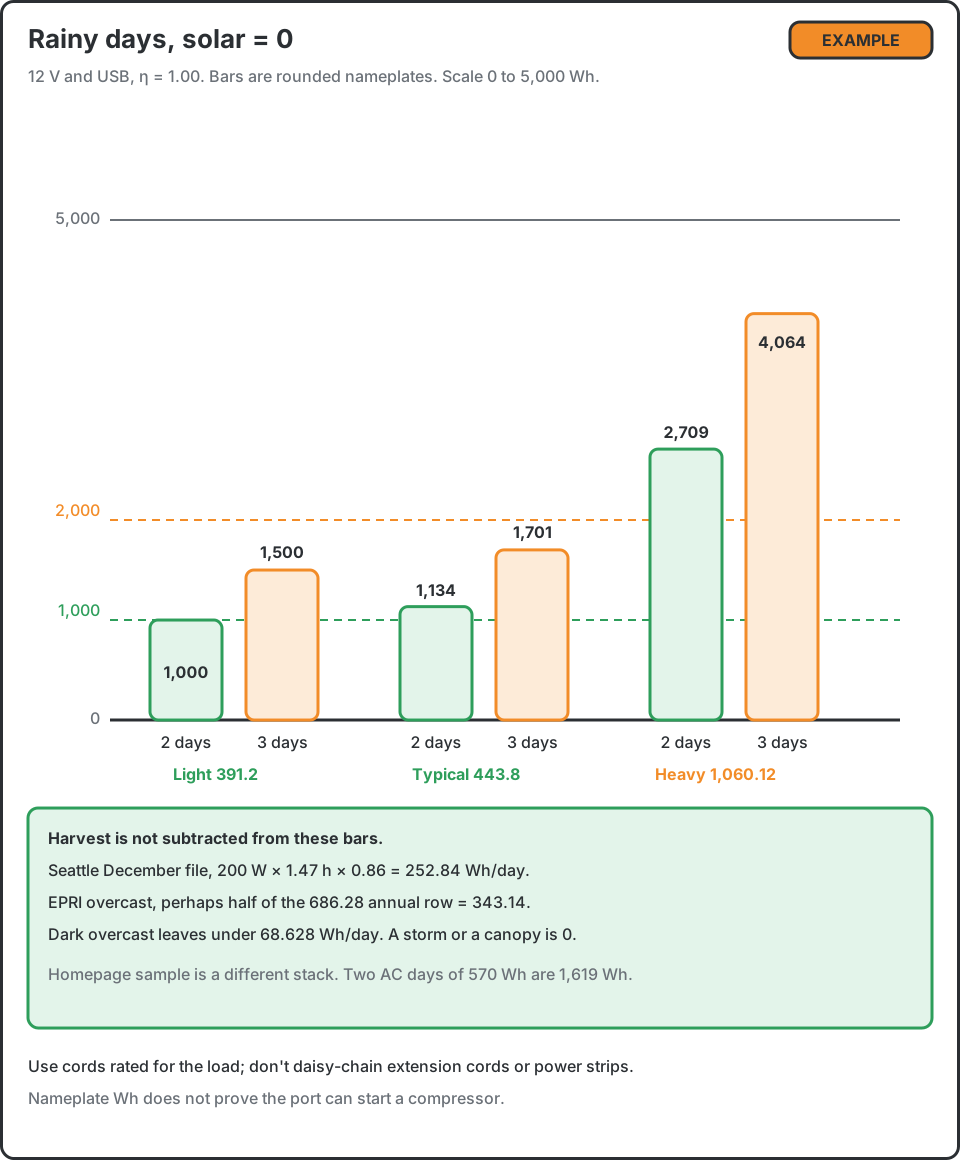
| Day | Wh/day | Days | 12 V exact | 12 V nameplate | All-AC exact | All-AC nameplate |
|---|---|---|---|---|---|---|
| Light | 391.2 | 2 | 999.733 | 1,000 Wh | 1,110.815 | 1,111 Wh |
| Light | 391.2 | 3 | 1,499.600 | 1,500 Wh | 1,666.222 | 1,666 Wh |
| Typical | 443.8 | 2 | 1,134.156 | 1,134 Wh | 1,260.173 | 1,260 Wh |
| Typical | 443.8 | 3 | 1,701.233 | 1,701 Wh | 1,890.259 | 1,890 Wh |
| Heavy | 1,060.12 | 2 | 2,709.196 | 2,709 Wh | 3,010.217 | 3,010 Wh |
| Heavy | 1,060.12 | 3 | 4,063.793 | 4,064 Wh | 4,515.326 | 4,515 Wh |
391.2 × 2 × 1.15 / 0.90 = 999.733 → 1,000 Wh
443.8 × 2 × 1.15 / 0.90 = 1,134.156 → 1,134 Wh
1,060.12 × 2 × 1.15 / 0.90 = 2,709.196 → 2,709 Wh
Worked light check, two days, 12 V. 391.2 × 2 = 782.4 Wh at the loads. 782.4 / 1.00 = 782.4 from the battery. 782.4 × 1.15 = 899.76. 899.76 / 0.90 = 999.733, which rounds to 1,000 Wh. Three days is 1,499.600, and 0.600 rounds up, so the nameplate is 1,500 Wh. The exact quotient is under 1,500.
Math only, not a setup. The heavy day with the CPAP on its AC supply, and everything else still on 12 V or USB. ResMed document 198103/7 warns: “Other ResMed heated humidifiers must not be used with inverters. Damage to the unit or serious injury to the user may result.” A station’s AC outlet is an inverter. These figures are watt-hour arithmetic only. They are not a setup and not an approval. Rest of the day is 443.8 + 144 = 587.8 Wh at η=1.00. The 472.32 Wh night is at η=0.90. Add the exact quotients, then round once.
| Pass | Wh/day | η | 2-day exact | 3-day exact |
|---|---|---|---|---|
| Rest of the heavy day, 12 V / USB | 587.8 | 1.00 | 1,502.156 | 2,253.233 |
| CPAP on the inverter (math only) | 472.32 | 0.90 | 1,341.156 | 2,011.733 |
| Sum of exact, then round once (math only) | 1,060.12 | split | 2,843.311 → 2,843 Wh (math only) | 4,264.967 → 4,265 Wh (math only) |
All-DC heavy for the same two days is 2,709 Wh. Moving only the CPAP onto the inverter adds the gap from 2,709 to 2,843 (math only). Do not apply η=0.90 to the fridge or the blanket on that split.
Two swaps that are not the named days. SlimLine only at the same 10 cm row is 89.28 Wh, not 472.32. The day becomes 443.8 + 144 + 89.28 = 677.08 Wh. Two days on 12 V: 1,730.316 → 1,730 Wh. A 2,000 Wh label covers 1,730 and misses 2,709. The blanket’s app timer allows up to 10 h. Holding 48 W for those 10 h is 480 Wh, not the 144 Wh controller step. With the heavy CPAP row the day becomes 1,396.12 Wh. Two days on 12 V: 3,567.862 → 3,568 Wh. That ceiling is not the heavy day.
Move the 52.6 Wh recharge onto an AC brick and leave the rest of the typical day on 12 V and USB. Two days: 391.2 at η=1.00 is 999.733, and 52.6 at η=0.90 is 149.358. Sum 1,149.091 rounds to 1,149 Wh, against 1,134 Wh when the laptop stays on USB-C.
Which label, and the margin
A label is nameplate Wh. On 12 V, delivered Wh = label × 0.90. On AC, delivered Wh = label × 0.81. Days below are delivered ÷ Wh/day. The buffer is not in that quotient. “Covers” means the round label is at least the rounded nameplate. Margin is label minus that nameplate. A positive margin is spare nameplate Wh. It is not spare delivered Wh, and it is not a start margin. Class spans on this site: results up to 512 Wh, then 513–1,152 Wh, then 1,153 Wh and up.
| Label | 12 V delivered | Days at 391.2 | Days at 443.8 | Days at 1,060.12 | AC delivered | Days at 570 |
|---|---|---|---|---|---|---|
| 500 Wh | 450 | 1.150 | 1.014 | 0.424 | 405 | 0.711 |
| 1,000 Wh | 900 | 2.301 | 2.028 | 0.849 | 810 | 1.421 |
| 2,000 Wh | 1,800 | 4.601 | 4.056 | 1.698 | 1,620 | 2.842 |
900 / 391.2 = 2.300613…, shown as 2.301. A 1,000 Wh label delivers 2.301 light days with the buffer off. The buffered two-day plan is the 1,000 Wh nameplate. The extra fraction is the buffer. It is not a third night you should spend. 810 / 570 = 1.421053… → 1.421. 1,620 / 570 = 2.842105… → 2.842. At one decimal those two are 1.4 and 2.8. Size from the three-decimal quotients.
| Plan | Nameplate | Class | 500 Wh | 1,000 Wh | 2,000 Wh |
|---|---|---|---|---|---|
| Light, 2 days, 12 V | 1,000 Wh | 513–1,152 | Short by 500 | Meets it. Margin 0 | Margin 1,000 |
| Light, 3 days, 12 V | 1,500 Wh | 1,153 and up | Short | Short by 500 | Margin 500 |
| Typical, 2 days, 12 V | 1,134 Wh | 513–1,152 | Short | Short by 134 | Margin 866 |
| Typical, 3 days, 12 V | 1,701 Wh | 1,153 and up | Short | Short by 701 | Margin 299 |
| Heavy, 2 days, 12 V | 2,709 Wh | 1,153 and up | Short | Short | Short by 709 |
| Heavy, 3 days, 12 V | 4,064 Wh | 1,153 and up | Short | Short | Short by 2,064 |
| Heavy, 2 days, CPAP on AC (math only; ResMed warns against this humidifier on an inverter) | 2,843 Wh | 1,153 and up | Short | Short | Short by 843 |
| Heavy, 3 days, CPAP on AC (math only; ResMed warns against this humidifier on an inverter) | 4,265 Wh | 1,153 and up | Short | Short | Short by 2,265 |
| Homepage sample, 2 days, AC | 1,619 Wh | 1,153 and up | Short | Short by 619 | Margin 381 |
| Homepage sample, 3 days, AC | 2,428 Wh | 1,153 and up | Short | Short | Short by 428 |
The light two-day exact quotient is 999.733. It rounds to 1,000, so a 1,000 Wh label meets the rounded plan and has no spare nameplate Wh. Typical for two days, 1,134 Wh, is inside the same class (ceiling 1,152) and 134 Wh above a 1,000 Wh label. All-AC light for two days is 1,111 Wh. A 1,000 Wh label covers the 12 V plan and misses that AC plan by 111 Wh. Heavy, on either path, is above a 2,000 Wh label. None of these rows prove the compressor will start.
Homepage sample, still 1,619 Wh
The sample other pages cite is a different day. Fridge planning band 320 Wh, laptop 70 W × 2 h = 140 Wh, lights 10 W × 5 h = 50 Wh, phones 60 Wh. Sum 570 Wh/day. The 320 band is not the CFX3 282 test point, and the 70 W, 10 W, and 60 Wh allowances are not the cited rows above. One AC pass, solar = 0. EcoFlow’s device-setup article uses watts × hours. EcoFlow’s camping guide adds a 20–30% buffer. WattNeeds does not adopt 20–30%. The buffer stays 0.15.
Two days, AC. Unrounded middles, then the exact nameplate:
- 570 × 2 = 1,140 Wh at the loads
- 1,140 / 0.90 = 1,266.667 Wh from the battery
- 1,266.667 × 1.15 = 1,456.667 Wh with buffer
- 1,456.667 / 0.90 = 1,618.519 → 1,619 Wh
nameplate = 570 × 2 × 1.15 / 0.81 = 1,618.519 → 1,619 Wh
The same two days on 12 V, only if the laptop and the lights are also 12 V or USB: 1,456.667 → 1,457 Wh. Three days on AC: 570 × 3 × 1.15 / 0.81 = 2,427.778 → 2,428 Wh. Three days on 12 V: 2,185.000 → 2,185 Wh. A 2,000 Wh label covers 1,619 (margin 381) and misses 2,428 (short by 428). Weekend camping carries the one-day 809 Wh row and the mixed 1,511 Wh split. Size the two-day AC sample from 1,618.519.
Bluetti’s public method divides by ~0.85 (Bluetti size guide). Jackery publishes watt-hours × 0.85 ÷ device watts (Jackery runtime formula). WattNeeds keeps η, DoD, and buffer as separate knobs.
What an overcast day adds
Do not type harvest into whPerDay and then shrink days. From sunset to sunrise the harvest term is zero, whatever the daily total was. The fridge cycles overnight. Keep the full load. Set days to the dark stretch.
The simple model is the one on solar vs battery: harvest Wh/day = panel W × peak sun hours × 0.86. The 0.86 is the PVWatts Version 5 manual conversion of its default system loss, “1 − 14/100 = 0.86.” It is an upper estimate at the battery. It is not cell temperature, and it is not a station’s charge efficiency. The hours are the Seattle PVWatts V8 requests already on that page, tilt 30°, azimuth 180°: annual 3.99, December 1.47 (PVWatts V8). December in that weather file already includes that month’s clouds. It is not a storm, and it is not a site under trees.
200 × 3.99 × 0.86 = 686.28 Wh/day
200 × 1.47 × 0.86 = 252.84 Wh/day
686.28 is the annual file at 200 W. It is not a rainy day. 252.84 is the December file at 200 W. Two such days are 505.68 Wh. Three are 758.52 Wh. Neither number comes off the nameplate.
Against the battery draw of these days (η=1.00, so the draw equals the load), one December day is short by 391.2 − 252.84 = 138.36 Wh on the light day, 443.8 − 252.84 = 190.96 Wh on the typical day, and 1,060.12 − 252.84 = 807.28 Wh on the heavy day. A station that clips solar input at 100 W, the cap already stated for the Jackery Explorer 100 Plus on the solar page, gets 100 × 1.47 × 0.86 = 126.42 Wh/day on that December row, not 252.84.
EPRI’s 2011 white paper 1023090 states a daily range, not a camp measurement: averaged over a day, reductions in output are proportional to reductions in irradiance, from less than 10% on mostly sunny days to perhaps 50% on overcast days and greater than 90% on dark and overcast days (EPRI 1023090). Applied only to the 686.28 annual row, as that range: perhaps half remains, 686.28 × 0.50 = 343.14 Wh/day, and a dark overcast day leaves less than 686.28 × 0.10 = 68.628 Wh/day. The word is “perhaps.” Do not apply the percent again to the December file. That file already contains its clouds. The same paper’s minute-scale ramps are a different fact. The daily band is not a promise that output holds steady through the afternoon.
The wrong resize, shown so it stays wrong. Subtract the December day from the light day, then size two days: (391.2 − 252.84) × 2 × 1.15 / 0.90 = 353.587 → 354 Wh. That nameplate covers the shortfall only. It does not cover the nights. A storm, or a canopy, is 0. The 1,000 Wh light plan and the 1,619 Wh sample do not get smaller because a December average exists.
Related: weekend camping · camping fridge · cooler vs fridge · solar vs battery · CPAP · van daily Wh · surge traps
Wh calculator — one η per pass. 12 V and USB: set inverter efficiency to 1.00. AC outlets: leave η at 0.90. Leave solar out of Wh/day. Days are the dark days.
Where to check pricing
As an Amazon Associate, we earn from qualifying purchases at no extra cost to you. EcoFlow, Jackery, and Bluetti partner programs are not live yet.
See on Amazon EcoFlow — Coming soon Jackery — Coming soon Bluetti — Coming soon