Ice cooler vs 12 V compressor fridge
Ice is about 0 electrical Wh, then a mass you have to replace. A compressor is an average Wh/day at one ambient and one setpoint. The average moves when the air outside the box moves. Sheets below were read 2026-11-02. WattNeeds did not test a cooler or a fridge.
Two different kinds of number
An ice chest draws no compressor current. The electrical day is whatever else you plug in. The cold is a mass of ice, and the mass leaves as meltwater. A 12 V compressor draws an average that Dometic defines as ampere-hours at a given ambient and a given internal setpoint (rated current vs energy consumption). Holding the rated watts for 24 hours counts the off time as on. The method, the 32°C test point, and the port-amp check live on Camping fridge. This page keeps ice against that compressor.
Duty cycle is a ratio of two printed cells
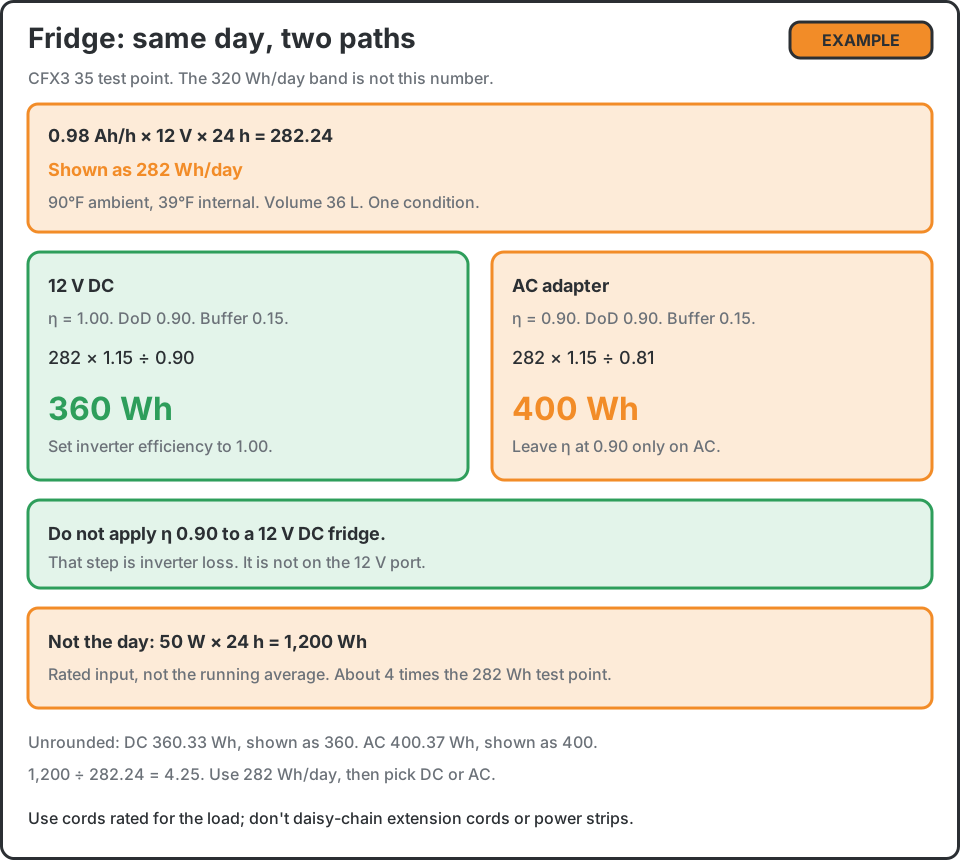
The US CFX3 35 sheet prints energy consumption 0.98 Ah/h at 12 V, ambient 90°F, internal 39°F, and rated DC current 7.5 A. 0.98 / 7.5 = 0.130666…, shown as 0.131. Dometic does not say the compressor is on 13.1% of the hour. The 7.5 A cell is a maximum. The 0.98 Ah/h cell is an average at one ambient and one setpoint. The ratio is those two printed numbers. It is not an on-time this site measured. 0.98 × 12 × 24 = 282.24, sized as 282 Wh/day. 7.5 × 12 × 24 = 2,160 Wh and 50 × 24 = 1,200 Wh are the rated inputs held all day. Both are the wrong daily product. One day of the 282 figure is 360 Wh on 12 V and 400 Wh on AC. The rest of that conversion is on Camping fridge.
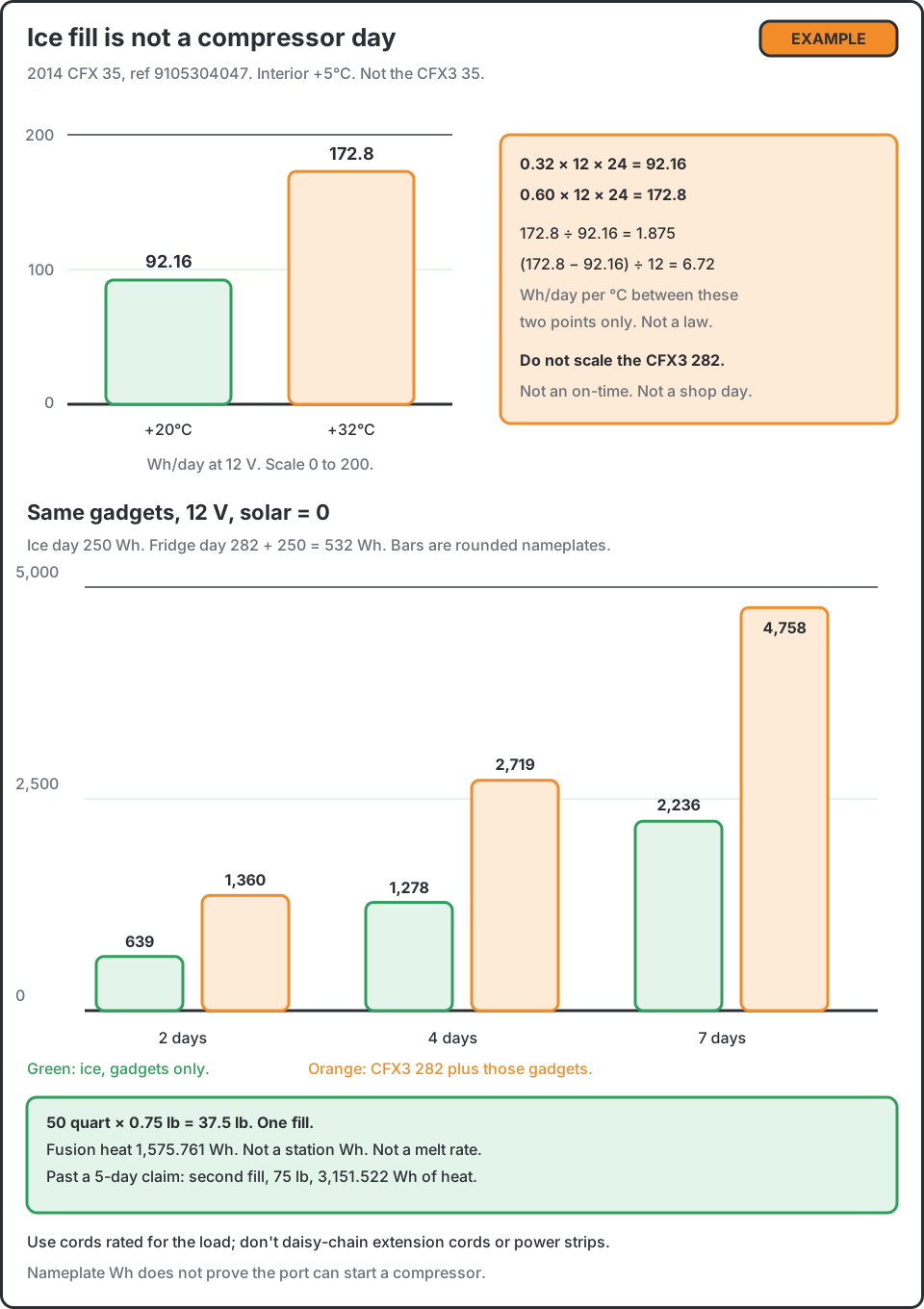
The CFX3 35 sheet prints one ambient. A second ambient is on a different cooler. The 2014 Dometic WAECO catalogue, More Comfort on Board, page 12 and the technical table on page 88, prints WAECO CoolFreeze CFX 35, ref 9105304047: current consumption at 12 V is 0.32 Ah/h at +20°C and 0.60 Ah/h at +32°C, both at +5°C interior. Storage volume about 32 L including 4.5 L for fresh food. Power input about 43 W. That model is not the CFX3 35. The host of the PDF used here is a distributor copy of that catalogue.
0.32 Ah/h × 12 V × 24 h = 92.16 Wh/day
0.60 Ah/h × 12 V × 24 h = 172.8 Wh/day
0.32 × 12 = 3.84 W average. 0.60 × 12 = 7.20 W average.
172.8 / 92.16 = 1.875
(172.8 − 92.16) / (32 − 20) = 80.64 / 12 = 6.72 Wh/day per °C
The 6.72 is the step between the two printed ambients, divided by the 12°C gap. It is not a coefficient for a third temperature, and it is not a coefficient for the CFX3. This page does not multiply 282 by 1.875. It does not multiply 320 by 1.875. The catalogue does not print a rated amp next to the 43 W, so 3.84 / 43 is not used as an on-time. 43 × 24 = 1,032 Wh if that approximate watt were held all day. 1,032 / 92.16 = 11.198. 1,032 / 172.8 = 5.972. Those quotients are how far the approximate-watt day sits above the two cells. They are not a measured duty cycle.
A later Dometic cooler buying guide prints a CFX-35W, SKU 9105306500, at 0.77 Ah/h, ambient 90°F, internal 41°F, rated 12 V current 7.0 A. 0.77 × 12 × 24 = 221.76 Wh. 0.77 / 7.0 = 0.11. That SKU is not 9105304047. 221.76 is not a stand-in for 172.8. 0.11 is not an on-time. No nameplate from 221.76. The 90°F cell is also not the CFX3’s 0.98 Ah/h. Do not average them.
Same gadgets, then the trip length
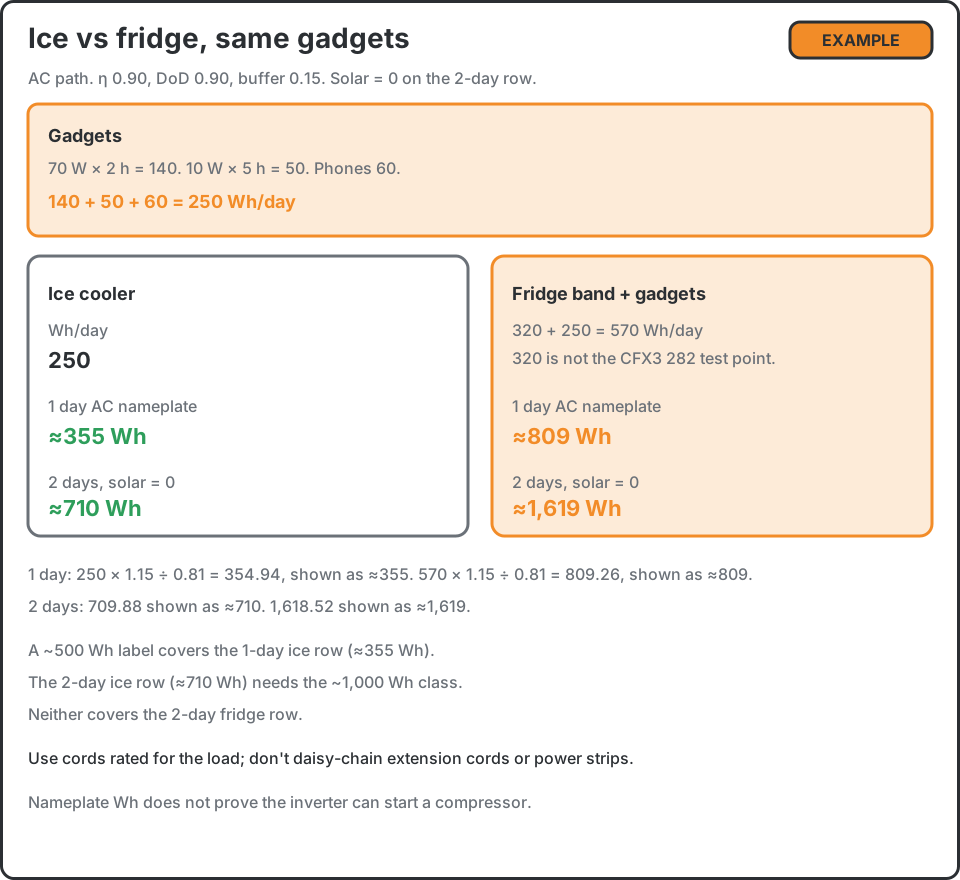
Gadgets are the figures already on this page: laptop 70 W × 2 h = 140 Wh, lights 10 W × 5 h = 50 Wh, phones 60 Wh. 140 + 50 + 60 = 250 Wh/day. They are a planning stack, not a measured camp. Ice adds 0 Wh. The CFX3 test point adds 282, so the day is 282 + 250 = 532 Wh. The homepage camping sample adds the unsourced 320 Wh/day band, so the day is 320 + 250 = 570 Wh. 320 is not 282. Camping fridge sizes a smaller stack, 282 + 50 + 60 = 392, because that page leaves the laptop off. Do not swap 392 in here.
A weekend of car camping is 2 days. A longer trip is 4 days and 7 days. Solar = 0 on every row. Steps are load ÷ η, × 1.15, ÷ 0.90. The published nameplate is Math.round of the full quotient. “Exact” is that quotient to three decimals.
| Load | Wh/day | Days | Path | Exact | Nameplate |
|---|---|---|---|---|---|
| Ice, gadgets only | 250 | 1 | 12 V | 319.444 | 319 Wh |
| Ice, gadgets only | 250 | 1 | AC | 354.938 | 355 Wh |
| Ice, gadgets only | 250 | 2 | 12 V | 638.889 | 639 Wh |
| Ice, gadgets only | 250 | 2 | AC | 709.877 | 710 Wh |
| Ice, gadgets only | 250 | 4 | 12 V | 1,277.778 | 1,278 Wh |
| Ice, gadgets only | 250 | 4 | AC | 1,419.753 | 1,420 Wh |
| Ice, gadgets only | 250 | 7 | 12 V | 2,236.111 | 2,236 Wh |
| Ice, gadgets only | 250 | 7 | AC | 2,484.568 | 2,485 Wh |
| CFX3 + gadgets | 532 | 1 | 12 V | 679.778 | 680 Wh |
| CFX3 + gadgets | 532 | 1 | AC | 755.309 | 755 Wh |
| CFX3 + gadgets | 532 | 2 | 12 V | 1,359.556 | 1,360 Wh |
| CFX3 + gadgets | 532 | 2 | AC | 1,510.617 | 1,511 Wh |
| CFX3 + gadgets | 532 | 4 | 12 V | 2,719.111 | 2,719 Wh |
| CFX3 + gadgets | 532 | 4 | AC | 3,021.235 | 3,021 Wh |
| CFX3 + gadgets | 532 | 7 | 12 V | 4,758.444 | 4,758 Wh |
| CFX3 + gadgets | 532 | 7 | AC | 5,287.160 | 5,287 Wh |
| 320 band + gadgets | 570 | 1 | 12 V | 728.333 | 728 Wh |
| 320 band + gadgets | 570 | 1 | AC | 809.259 | 809 Wh |
| 320 band + gadgets | 570 | 2 | 12 V | 1,456.667 | 1,457 Wh |
| 320 band + gadgets | 570 | 2 | AC | 1,618.519 | 1,619 Wh |
| 320 band + gadgets | 570 | 4 | 12 V | 2,913.333 | 2,913 Wh |
| 320 band + gadgets | 570 | 4 | AC | 3,237.037 | 3,237 Wh |
| 320 band + gadgets | 570 | 7 | 12 V | 5,098.333 | 5,098 Wh |
| 320 band + gadgets | 570 | 7 | AC | 5,664.815 | 5,665 Wh |
250 × 2 × 1.15 / 0.90 = 638.889 → 639 Wh
532 × 2 × 1.15 / 0.90 = 1,359.556 → 1,360 Wh
570 × 2 × 1.15 / 0.81 = 1,618.519 → 1,619 Wh
532 × 7 × 1.15 / 0.90 = 4,758.444 → 4,758 Wh
“Energy covers” means the round label is at least the buffered nameplate. It does not mean the compressor starts. A 500 Wh label covers the 1-day ice rows (319 and 355) and none of the fridge rows. A 1,000 Wh label covers a 2-day ice trip (639 and 710) and a 1-day CFX3 stack (680 and 755). It does not cover a 2-day CFX3 stack (1,360 and 1,511) or a 2-day 320-band stack (1,457 and 1,619). A 2,000 Wh label covers those 2-day fridge rows and the 4-day ice rows (1,278 and 1,420). It does not cover a 4-day CFX3 stack (2,719 and 3,021), a 7-day ice trip (2,236 and 2,485), or any 7-day fridge row. Class edges on this site stay results up to 512 Wh, then 513–1,152, then 1,153 and up. A 2-day ice DC plan (639) sits in 513–1,152. A 2-day CFX3 plan (1,360) sits in 1,153 and up.
From the battery, before buffer and DoD, the 12 V path takes the load itself. The AC path takes load / 0.90. For the CFX3 stack, 532 / 0.90 = 591.111 Wh from the battery for one day. The 12 V path takes 532 Wh. The difference is 59.111 Wh, the inverter term this site models. It is not a measured inverter. The 320-band day on AC is 570 / 0.90 = 633.333 Wh from the battery, the same battery draw solar vs battery already uses for camping on the AC path.
Ice is pounds, then a receipt
Coleman prints two sentences that belong together. The cooler use guide says five-day performance requires that guide, that the line is internal testing in a controlled environment, and that user experience may vary. It recommends 0.75 lb of ice per rated quart, and calls that about a 2:1 ice-to-contents ratio. The 50-quart Xtreme 5-day wheeled cooler (SKU 3000005357) is titled 50 quarts, and one bullet says “Keeps the Ice!” at 5-day ice retention at temperatures up to 90°F. The description also says up to 5 days. This page treats the title as the rated quarts. It did not weigh a fill.
0.75 lb/qt × 50 qt = 37.5 lb for one fill
A 2-day weekend and a 4-day trip both sit inside that 5-day claim, so the planning ice is one fill. A 7-day trip is two days past the claim, so the planning ice is a second fill of the same size, 75 lb. The claim does not say the chest is empty at hour 120. Dividing 37.5 lb by 5 and calling the result a daily melt is not on the page. Customer comments on the product page are not a protocol and are not used.
The heat that melts ice at 0°C, without warming the water, is the heat of fusion. Osborne’s 1939 revision for the National Bureau of Standards gives 333.5 international joules per gram, estimated uncertainty 0.2 J/g. This page uses 333.5 as printed. It does not widen the watt-hours for the 0.2, and it does not convert international joules into a different SI joule. One watt-hour is taken as 3,600 of those joules. The pound is the avoirdupois pound in NIST Handbook 44, Appendix C (2026): 453.592 37 grams exactly.
37.5 × 453.59237 = 17,009.713875 g
333.5 × 17,009.713875 / 3,600 = 1,575.761 Wh of fusion heat
75 lb → 3,151.522 Wh of fusion heat
That watt-hour is heat absorbed while the ice becomes water at 0°C. It is not a station nameplate, not the heat leak of the chest, and not the electrical Wh a compressor uses to move heat. A compressor moves heat; its electrical input is not the same number as the heat it moves. These two Wh figures do not cancel. Do not subtract 1,575.761 from 1,360 and call the difference a savings. Keep perishable food at 40°F (4°C) or below.
The same use guide says 10 cans, or 1 gallon (3.7 L), will use approximately 2.5 lb (1.13 kg) of ice just to cool from room temperature. That sentence is the cost of skipping the pre-chill, for that one load. It is not already inside the 0.75 lb/qt line. 2.5 × 453.59237 = 1,133.980925 g, which is 1.134 kg and matches their 1.13 kg as a rounded kilogram. 333.5 × 1,133.980925 / 3,600 = 105.051 Wh of fusion heat. Do not also convert the printed 1.13 kg into a second heat figure. Add the 2.5 lb only when the food was not pre-chilled.
No national price for bagged ice is used. The receipt is the pounds times the price printed on the bag:
one fill, dollars = 37.5 × (bag price / bag pounds)
two fills, dollars = 75 × (bag price / bag pounds)
Leave the bag price blank until you read one. A house electricity rate is not the camp cost of either path. The compressor’s camp cost, on the days you do not recharge, is the nameplate in the table above. The ice path’s camp cost is the fill, and then another fill when the claim no longer covers the days.
A van, full time
The mild parked day on van life is 282 + 25.2 + 44 + 40 + 52.6 + 192 = 635.8 Wh. Swapping the compressor for ice drops the 282 and leaves 25.2 + 44 + 40 + 52.6 + 192 = 353.8 Wh/day. That 353.8 is the “rest of the mild day” already named on the van page. One day of it on 12 V is 452.078 → 452 Wh, the figure that page already rounds. The rows below put the ice swap and the compressor day on the same days, solar = 0. Full time does not mean seven days with the panels covered. It means the daily gap repeats, and a dark stretch is still sized with solar = 0.
| Day | Wh/day | Days | Path | Exact | Nameplate |
|---|---|---|---|---|---|
| Ice instead of the compressor | 353.8 | 1 | 12 V | 452.078 | 452 Wh |
| Ice instead of the compressor | 353.8 | 1 | AC | 502.309 | 502 Wh |
| Ice instead of the compressor | 353.8 | 7 | 12 V | 3,164.544 | 3,165 Wh |
| Ice instead of the compressor | 353.8 | 7 | AC | 3,516.160 | 3,516 Wh |
| Mild day, compressor in | 635.8 | 1 | 12 V | 812.411 | 812 Wh |
| Mild day, compressor in | 635.8 | 1 | AC | 902.679 | 903 Wh |
| Mild day, compressor in | 635.8 | 7 | 12 V | 5,686.878 | 5,687 Wh |
| Mild day, compressor in | 635.8 | 7 | AC | 6,318.753 | 6,319 Wh |
635.8 − 353.8 = 282
282 × 7 × 1.15 / 0.90 = 2,522.333 → 2,522 Wh on 12 V
282 × 7 × 1.15 / 0.81 = 2,802.593 → 2,803 Wh on AC
The unrounded gap is the fridge-only quotient, because 635.8 − 353.8 = 282. Subtracting the three-decimal displays gives 5,686.878 − 3,164.544 = 2,522.334, which is 0.001 over 2,522.333. Do not shop that 0.001. The rounded labels differ by 5,687 − 3,165 = 2,522 Wh. That match is this pair of labels. It is not a reason to subtract other rounded labels. A 2,000 Wh label covers one mild day (812 / 903) and one ice-swap day (452 / 502). It does not cover seven days of either row. The ice path still needs the fill in the section above, on a cadence the 5-day claim does not measure in a parked van. Hot-cabin what-ifs stay on van life. This page does not invent a van ice-retention day.
A panel does not shrink the nameplate
The calculator has no solar field. Harvest, when a panel is actually aimed, is the formula on solar vs battery:
harvest Wh/day = panel W × peak sun hours × 0.86
The 0.86 and the planning hours are that guide’s: Seattle annual 3.99 h, Seattle December 1.47 h. This page does not open a new weather file. 3.99 × 0.86 = 3.4314. 1.47 × 0.86 = 1.2642. 100 × 3.4314 = 343.14 Wh/day. 200 × 3.4314 = 686.28 Wh/day. 200 × 1.2642 = 252.84 Wh/day. Those three products are already on the solar guide. A 12 V load asks the battery for the load itself, because η=1.00.
| 12 V load | 100 W, 3.99 h | 200 W, 3.99 h | 200 W, December 1.47 h | Panel W at 3.99 h | Panel W in December |
|---|---|---|---|---|---|
| Ice gadgets, 250 Wh | 343.14 − 250 = 93.14 over | 686.28 − 250 = 436.28 over | 252.84 − 250 = 2.84 over | 250 / 3.4314 = 72.857 W | 250 / 1.2642 = 197.754 W |
| CFX3 + gadgets, 532 Wh | 532 − 343.14 = 188.86 short | 686.28 − 532 = 154.28 over | 532 − 252.84 = 279.16 short | 532 / 3.4314 = 155.039 W | 532 / 1.2642 = 420.819 W |
| Van, ice swap, 353.8 Wh | 353.8 − 343.14 = 10.66 short | 686.28 − 353.8 = 332.48 over | 353.8 − 252.84 = 100.96 short | 353.8 / 3.4314 = 103.107 W | 353.8 / 1.2642 = 279.861 W |
| Van, compressor in, 635.8 Wh | 635.8 − 343.14 = 292.66 short | 686.28 − 635.8 = 50.48 over | 635.8 − 252.84 = 382.96 short | 635.8 / 3.4314 = 185.289 W | 635.8 / 1.2642 = 502.927 W |
The 50.48 Wh surplus of 686.28 over the 635.8 van day is the same gap the solar guide already prints. The 61.14 Wh surplus of 343.14 over a fridge-only 282 is the gap Camping fridge already prints for a 100 W panel. Do not type a surplus into the calculator. Keep the load. Set days to the dark stretch. A storm, or a site under trees, is the solar = 0 table above, which is also the case on rainy weekend. From sunset to sunrise the harvest term is zero. The nameplate does not get smaller because a noon hour was sunny.
Pass / fail
“Energy covers” is the label against the buffered nameplate. It is not a compressor start, and it is not a promise the ice is still there on the last morning.
| Plan | Result |
|---|---|
| 1-day ice, gadgets 250 Wh, 12 V 319 / AC 355 | A 500 Wh label covers the energy. There is no compressor to start. The ice is a separate 37.5 lb if you use the 50-quart title at 0.75 lb/qt. |
| 2-day weekend, ice, 639 / 710 | A 500 Wh label is short. A 1,000 Wh label covers the energy. One ice fill is inside the 5-day claim. The claim is not a weighed remainder. |
| 2-day weekend, CFX3 + gadgets, 1,360 / 1,511 | A 1,000 Wh label is short. A 2,000 Wh label covers the energy. The start and the 7.5 A port check are on Camping fridge. |
| 2-day weekend, 320 band + gadgets, 1,457 / 1,619 | Same station result as the CFX3 row: 1,000 is short, 2,000 covers. 320 is unsourced and is not the 282 test point. The AC 1,619 is the figure already on this page and on rainy weekend. |
| 4-day trip, ice, 1,278 / 1,420 | A 1,000 Wh label is short. A 2,000 Wh label covers the energy. Still one fill against the 5-day claim. |
| 4-day trip, CFX3 + gadgets, 2,719 / 3,021 | A 2,000 Wh label is short of both. Solar = 0 is the miss. A panel is the section above, and it is not subtracted here. |
| 7-day trip, ice, 2,236 / 2,485 | A 2,000 Wh label is short. Planning ice is two fills, 75 lb, because day 7 is past the 5-day claim. That second fill is not a measured empty time. |
| 7-day trip, CFX3 + gadgets, 4,758 / 5,287 | A 2,000 Wh label is short by a wide margin. This is the no-recharge bound, not a packed station. |
| Van, one mild day, 812 / 903, or ice swap 452 / 502 | A 500 Wh label covers 452 and misses 502, 812, and 903. A 1,000 Wh label covers all four one-day rows. Seven days of either day misses a 2,000 Wh label. |
| 2014 CFX 35 pair, 92.16 and 172.8 | Not a shop day. The 1.875 ratio and the 6.72 Wh/day per °C stay between those two printed points. They are not applied to 282 or to 320. |
| CFX-35W SKU 9105306500, 221.76 Wh | Fail as a plan. Different SKU from 9105304047. Not blended with 172.8 or with 282. |
| Bagged-ice dollars | No national price. 37.5 or 75 times the price per pound on the bag you buy. A residential ¢/kWh is not this camp. |
Related: Camping fridge (Wh/day method, 282, duty-cycle ratio, port amps) · Weekend camping · Rainy weekend (solar = 0) · Van life (the 635.8 day) · Solar vs battery · Surge traps
Wh calculator — enter the fridge as Wh/day and leave watts blank. Ice: enter the gadgets only. 12 V port: set inverter efficiency to 1.00. AC adapter: leave η at 0.90. nameplate = (Wh/day × days × 1.15) / (0.90 × η).
Where to check pricing
As an Amazon Associate, we earn from qualifying purchases at no extra cost to you. EcoFlow, Jackery, and Bluetti partner programs are not live yet.
See on Amazon EcoFlow — Coming soon Bluetti — Coming soon